


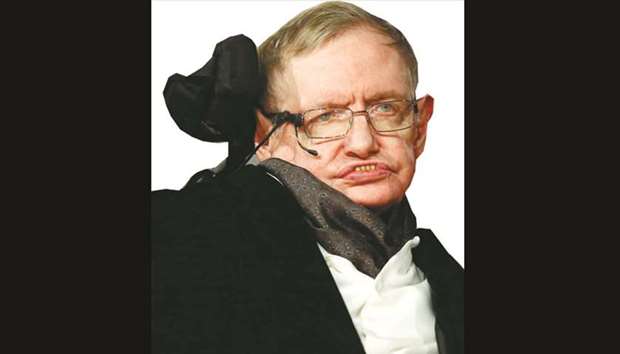

Students wait in line to sign a book of condolence opened at Gonville and Caius College, where Stephen Hawking was a fellow for over 50 years, at Cambridge University in Cambridge.
Stephen Hawking, who sought to explain the origins of the universe, the mysteries of black holes and the nature of time itself, died yesterday aged 76.
Hawking’s formidable mind probed the very limits of human understanding both in the vastness of space and in the bizarre sub-molecular world of quantum theory, which he said could predict what happens at the beginning and end of time.
Ravaged by the wasting motor neurone disease he developed at 21, Hawking was confined to a wheelchair for most of his life.
As his condition worsened, he had to speak through a voice synthesiser and communicating by moving his eyebrows — but at the same time became the world’s most recognisable scientist.
Hawking died peacefully at his home in the university city of Cambridge in the early hours of yesterday. “He was a great scientist and an extraordinary man whose work and legacy will live on for many years,” his children Lucy, Robert and Tim said. “His courage and persistence with his brilliance and humour inspired people across the world.”
Hawking shot to international fame after the 1988 publication of A Brief History of Time, one of the most complex books ever to achieve mass appeal, which stayed on the Sunday Times best-sellers list for no fewer than 237 weeks.
“My original aim was to write a book that would sell on airport bookstalls,” he told reporters at the time. “In order to make sure it was understandable I tried the book out on my nurses. I think they understood most of it.”
The physicist’s disease spurred him to work harder but also contributed to the collapse of his two marriages, he wrote in a 2013 memoir My Brief History.
In the book he related how he was first diagnosed: “I felt it was very unfair — why should this happen to me,” he wrote. “At the time, I thought my life was over and that I would never realise the potential I felt I had. But now, 50 years later, I can be quietly satisfied with my life.”
Prime Minister Theresa May said: “Stephen Hawking was a brilliant and extraordinary mind - one of the great scientists of his generation. His courage, humour and determination to get the most from life was an inspiration. His legacy will not be forgotten.”
US space agency Nasa said: “His theories unlocked a universe of possibilities that we and the world are exploring.”
Tim Berners-Lee, inventor of the World Wide Web, said: “We have lost a colossal mind and a wonderful spirit.”
Hawking’s popular recognition became such that he appeared as himself on the television show Star Trek: Next Generation and his cartoon caricature appeared on The Simpsons.
He narrated a segment of the opening ceremony of the London Paralympic Games in August 2012, the year he turned 70.
A 2014 film, The Theory of Everything, with Eddie Redmayne playing Hawking, charted the onset of his illness and his early life as a brilliant student.
He caused some controversy among biologists when he said he saw computer viruses as a life form, and thus the human race’s first act of creation.
“I think it says something about human nature that the only form of life we have created so far is purely destructive,” he told a forum in Boston. “We’ve created life in our own image.”
Another major area of his research was into black holes, the regions of space-time where gravity is so strong that nothing, not even light, can escape.
He married undergraduate Jane Wilde in July 1965 and the couple had Robert, Lucy and Timothy.
But Hawking tells in his 2013 memoir how Wilde became more and more depressed as her husband’s condition worsened.