


For the first time in half a decade, Colombia will elect a new congress tomorrow without the threat of leftist rebels who traditionally marred such voting with violence.
The former Revolutionary Armed Forces of Colombia, or Farc, are now a political party fielding candidates under a 2016 peace accord that ended Latin America’s longest and most potent insurgency.
A smaller rebel group, the National Liberation Army, is observing a truce tomorrow.
The government of President Juan Manuel Santos, whose term ends on August 7, is trying to reach a similar peace accord with those guerrillas — but talks have been suspended because attacks have resumed.
Abstention is usually around 60% in Colombia, but the elections will still be crucial for the future of the peace process and the survival of the left.
And they could also set the stage for the return of right-wing politicians who could allude to the economic crisis in neighbouring socialist-ruled Venezuela as a scare tactic.
Members of the right have also called to amend the peace accord reached with the Common Alternative Revolutionary Force, as the Farc now calls itself, using the same Spanish acronym.
The former rebels come into the election as a leftist force that still must confess to wartime atrocities and pay reparations to victims.
The peace accord, which established a special system of justice for wartime abuses and is due to take effect this year, guarantees the Farc at least 10 of the 280 seats in congress.
But the Farc still have to take part in the election, and none of the public opinion polls carried out shows it capable of winning more than those 10 seats.
“Even though they will probably not achieve the result they hope for, what is at stake for the Farc is positioning and the possibility of establishing itself with an eye to what really interests it politically: elections” for mayor and governor in 2020, said Carlos Arias Orjuela, a political consultant at Externado University.
What is more, the Farc suffered a setback on Thursday with word that its leader Rodrigo “Timochenko” Londono will not run in the presidential election in May as previously planned because he suffered a heart attack.
Tomorrow’s legislative elections kick off a poll season that will see a successor to Santos chosen on May 27.
Leftist and conservative coalitions will pick their candidates in internal party proceedings.
An ex-guerrilla and former mayor, Gustavo Petro, is heavily favoured to be the leftist candidate while Ivan Duque is the favourite for the right, and has the support of senator and former president Alvaro Uribe.
Both men are doing well in pre-election polls.
But the conservative Uribe could end up being the big winner: he could not only hold on to his seat tomorrow but also end up leading the conservatives in the legislature.
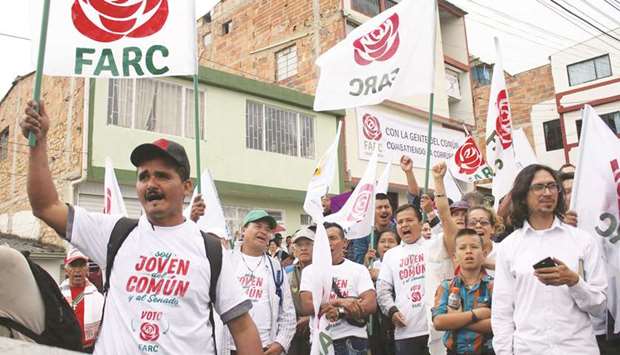
Members of the Farc campaign before legislative elections in Fusagasuga, Colombia.