


 |
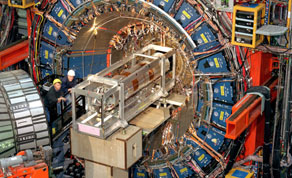
| Fermilab’s three-storey CDF detector that records snapshots of particles that emerge when protons and antiprotons collide at the Tevatron particle accelerator in Batavia, Illinois |
Physicists at Fermi National Accelerator Lab said yesterday that they have come tantalisingly close to proving the existence of the elusive subatomic Higgs boson - dubbed the “God particle” because it brings mass and order to the universe.
But the debris from trillions of collisions between beams of protons and anti-protons over 10 years at Fermilab’s now-shuttered Tevatron accelerator outside Chicago still fell short of the scientific threshold proving the discovery. The same collision debris hinting at the existence of the Higgs could also come from other subatomic particles.
Tomorrow, physicists at CERN, the European particle accelerator near Geneva, are scheduled to announce their own findings in the Higgs hunt. CERN houses the world’s most powerful particle accelerator, the Large Hadron Collider (LHC).
“This is the best answer that is out there at the moment,” said Fermilab physicist Rob Roser. “The Tevatron data strongly point toward the existence of the Higgs boson, but it will take results from the experiments at the Large Hadron Collider in Europe to establish a firm discovery.”
Physicists not connected to Fermilab also expressed cautious optimism that the long-sought particle had finally deigned to make an appearance.
“These intriguing hints from the Tevatron appear to support the results from the LHC shown at CERN in December,” said Dan Tovey, Professor of Particle Physics at the University of Sheffield. “The results are particularly important because they use a completely different and complementary way of searching for the Higgs boson. This gives us more confidence that what we are seeing is really evidence of new physics rather than just a statistical fluke.”
No one was ready to declare victory, however. “We will need to wait until Wednesday and the latest results from the LHC before getting the full picture,” said Tovey. And although CERN spokesman James Gillies called Fermilab’s “a nice result,” he quickly added that “it will be interesting to see how it lines up with CERN’s results tomorrow. Nature is the final arbiter so we’ll have to be a little more patient before we know for sure whether we’ve found the Higgs.”