


 |
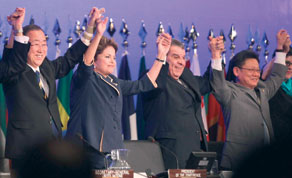
| From left to right: UN Secretary General Ban Ki-moon, Brazilian President Dilma Roussef, President of the UN General Assembly Nassir Abdulaziz al-Nasser and General Secretary of the Conference Sha Zukang who participated in the closing ceremony of the UN Conference on Sustainable Development Rio+20 in Rio de Janeiro on Friday |
The biggest UN summit on sustainable development in a decade approved a strategy on Friday to haul more than a billion people out of poverty and cure the sickness of the biosphere.
But critics branded the plan a cruel failure, saying it had been gutted of ambition by national interests.
The gathering of 191 UN members crowned a 10-day forum marking 20 years since the Rio Earth Summit, where leaders vowed the world would live within its environmental means.
In a sprawling 53-page statement, the three-day summit voiced dismay at entrenched poverty and mounting ecological stress.
“We... renew our commitment to sustainable development, and to ensure the promotion of an economically, socially and environmentally sustainable future for our planet and for present and future generations,” it said.
Entitled “The Future We Want,” the statement highlighted the many perils facing a planet whose human population is set to surge from 7bn today to 9.5bn by 2050.
The long list includes climate change, desertification, fisheries depletion, pollution and deforestation, and the danger that thousands of species will go the way of the dodo.
“Sustainable Development Goals” will replace the UN’s Millennium Development Goals from 2015, although defining the aim will be left for future talks - a process likely to be long and fiercely fought.
The strategy also promotes the green economy, a concept that breaks new ground in official UN terminology but is viewed suspiciously by many developing economies.
The statement also reflected the worries of advanced economies battling a deep financial crisis.
Despite the demands of developing nations for $30bn in help, the text stipulated no funding figures to achieve sustainability goals.
UN Secretary General Ban Ki-moon said the outcome “provides a firm foundation for social, economic, environmental well-being.” “It will guide us, all of us, towards a sustainable path. It is now our responsibility to build on it.”
President Dilma Rousseff told a press conference that Brazil, the host country, had secured the compromise after months of haggling. “The consensus is a point of departure, not arrival,” she cautioned.
“With this document, nations move forward. We cannot allow anyone to remain behind. The next conference will have to be a leap forward.”
US Secretary of State Hillary Clinton said the document “marks a real advance for sustainable development. We know this is one of the most pressing matters of our time.”
But others said a historic opportunity had been thrown away.
“The two defining challenges we face today are eradicating global poverty and managing the risks of climate change,” said British economist Lord Nicholas Stern, author of a landmark study into the costs of global warming.
“But the conference has failed to acknowledge the compelling evidence about the scale and urgency of action required.”
A registry that was opened during the conference showed that nearly 700 commitments, mobilising $513bn, had been made for sustainable development by governments and businesses, the UN said on Friday.
It gave no details about whether the funding was new or the criteria for determining whether the projects were sustainable.
In the green movement, many activists branded Rio+20 a disappointment to rank alongside the 2009 Copenhagen climate summit, a near-fiasco.
“The only people dancing in Rio tonight will be those who continue to benefit from a broken economic model that puts profit ahead of people and planet,” said Asad Rehman of Friends of the Earth.
“Rio+20 has been a failure of epic proportions,” said Greenpeace’s executive director, Kumi Naidoo.
“We must now work together to form a movement to tackle the equity, ecology and economic crises being forced on our children. The only outcome of this summit is justifiable anger, an anger that we must turn into action.”