


Chief Justice Maria Lourdes Sereno is suffering from a significant mental disturbance, which makes her unfit for her post, a clinical psychologist told lawmakers.
The psychologist, Geraldine Tria, gave the testimony on Tuesday, after a four-hour-long closed-door session conducted by the House justice panel that is hearing the impeachment complaint filed by lawyer Lorenzo Gadon against Sereno.
Tria said that based on the accounts of psychiatrists, Dulce Sahagun and Genuina Ranoy and psychologists Maria Suerte Caguingin and Bernaden de Leon-Jamon, who conducted the psychological test on Sereno when she applied for the job of chief justice in 2012, Sereno exhibited five out of nine strong manifestations of mental disturbance, namely: grandiosity, thirst for unlimited power, sense of entitlement, exploiting other people to her advantage and lack of empathy.
In August 2012, Manila Times published an exclusive story on the 11-page psychiatric report on Sereno, in which the chief justice got a rating of 4 out of 5, with 5 being the lowest.
The report described Sereno as dramatic and emotional, and that “she appears energetic and all smiles and agreeable, but with religious preoccupation in almost all significant aspects of her life. She projects a happy mood but has depressive markers, too.”
Tria said: “Definitely, I won’t give her (Sereno) a four because of her marginal performance.”
“Her position requires diversionary thinking, she is limited on that, and on her personality, maintaining relationships…she has been failing on those. Her being emotional and dramatic affects the workforce,” she added.
Tria, however, said she did not see Sereno’s psychological exam.
“Based on the findings (of the psychologists), she is not recommendable (for the post of chief justice post),” she insisted.
Psychologists, Caguingin and de Leon-Jamon, Tria’s former students, agreed with Tria but did not elaborate since they already expressed their opinions during the closed-door session.
But for lawyer Maria Milagros Cayosa of the Judicial and Bar Council (JBC), Sereno’s psychological evaluation score is not a ground to disqualify her as an applicant for the chief justice post.
The JBC screens applicants to the judiciary and submits recommendations to the president.
“There were those who got a score of one, there were those who got a score of two, there were those who got a score of three, there were those who got a score of four. If it is a five, then that would mean that the applicant has a diagnosable psychological disorder. The numerical scale is not a basis for disqualification, unless (it reaches the level of five wherein) there is a diagnosable psychiatric disorder that would affect the stability of the candidate,” Cayosa told lawmakers in the same hearing.
While Cayosa did not say that Sereno got a four, she explained that a score for four would mean that the applicant’s negative defences were predominantly present, which may reflect in a clinical observation as difficulty with adaptive functions in several areas of the person’s life.
“We have always adopted a policy that we do not rank the applicants based on the psychological evaluation,” Cayosa added.
Sereno’s spokesman, lawyer Jojo Lacanilao, said the results of the chief justice’s psychological evaluation was not a basis for impeachment.
“Congress’ concerns about removal from office should focus on the specific grounds stated in the Constitution, and the psychological report is not one of them. Expanding and redefining the grounds for impeachment is itself a violation of the constitutional provision,” Lacanilao said in a statement.
Under the Constitution, the chief justice may be removed from office upon conviction in an impeachment trial of culpable violation of the Constitution, treason, bribery, graft and corruption, other high crimes, or betrayal of public trust.
Lacanilao also balked at accusations that Sereno flunked the psychological evaluation by scoring a mere four. “She did not flunk or fail anything,” Lacanilao said.
He said the fact that the JBC included Sereno in the shortlist of candidates to be appointed chief justice by then president Benigno Aquino, and was later appointed to the post, meant Sereno was qualified.
“The fact of the matter is the JBC (members) litigated her qualification, President Aquino litigated her qualification, and they said she was qualified and these are the only people who would decide on her qualification,” Lacanilao said.
Another Sereno spokesman, Josa Deinla, echoed Lacanilao, saying Sereno could not have served in the Supreme Court for seven years — two as associate justice and five as chief justice — if she was psychologically unfit.
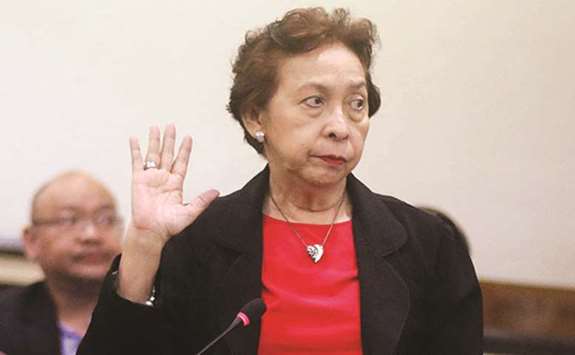
Psychologist Geraldine Tria