


“Arre, mey ne kuch achieve nahi kiya (I haven’t achieved anything)... There’s a long way to go. I feel my career has just started. Haan... let me tell you that,” said Sridevi, laughing.
Sridevi’s lilting laughter — much like her screen presence, beauty, grace and unmatchable talent — lingers on as I remember my last conversation, in November 2017, with the actress, who spent 50 of her 54 years of life living the cinematic dream.
“I feel like a newcomer. I feel that my career is going to start now. It’s not finished; it’s going to start now,” she asserted, dismissing any desire to treat her fans to an autobiography replete with stories from her glorious life — starting as a child actor at four to superstardom in India.
Born in Sivakasi in Tamil Nadu on August 13, 1963, Sridevi began her career at the age of four in the devotional film Thunaivan. That marked the beginning of a journey in filmdom that saw her work across Tamil, Telugu, Kannada, Malayalam and Hindi productions, leading her to become one of the most formidable actresses of the 1980s and 1990s in Bollywood — in fact, the only female “superstar” the industry has seen.
As filmmaker Ram Gopal Varma put it, “She was like a creation of God which he does whenever he is in a very special mood as a very, very special gift to mankind.”
Sridevi grew up to be known for not just her ability for slip into myriad roles — whether the double role in ChaalBaaz, as a woman with retrograde amnesia in Sadma, a shape-shifting woman in Nagina, a goofy crime journalist in Mr. India, the warm mother act in English Vinglish or the fierce and vengeful mom in Mom — but also for her expressive eyes, sheer comic timing and her fluid dancing skills, all of which made her a director’s delight.
Hawaa hawai, Main teri dushman, Morni, Na jaane kahan se aayi hai, Mere haathon mein are some of the iconic and classic dance numbers which gave cinema fans a chance to see the dancing talent of Sridevi.
As filmmaker Subhash Ghai, who directed her in Karma, said: “Introvert by nature, she was electricity with thunder in front of the camera. She would shock directors with each shot — be it dance, drama or romance. She was uncrowned queen of acting in all languages in her time.”
In 2013, the government feted her with the Padma Shri, the country’s fourth-highest civilian award. Her work was widely lauded with a slew of other richly-deserved honours.
Sridevi, who over the years became quite a fashion icon — sometimes giving tough competition to her daughters — commanded popularity like few others.
“Her popularity and stardom had to be seen to be believed. We were shooting for the climax in Nandyal for Kshana Kshanam and the whole of Nandyal came to a standstill when they came to know that Sridevi was in town.
“Banks, government offices, schools, colleges everything in town closed as everyone wanted to see Sridevi,” Ram Gopal Varma recounted in a tribute after the sudden demise of the actress in Dubai late Saturday of a cardiac arrest.
Sridevi could also be extraordinarily warm and compassionate.
Co-producer K. Ramji of Tina Films International, told IANS: “In 1986, while shooting for Sindoor, the heroine Neelam Kothari was staying in the same hotel as Sridevi. Neelam was a great fan and wanted to meet her, but was apprehensive about approaching an established star like Sridevi.
“Finally, when she took courage and entered her room, Sridevi got up to receive and welcome her, commented on Neelam’s lustrous hair and they became instant friends.”
In an industry where women beyond a certain age struggle to find roles, a 50-plus Sridevi proved she still had it in her when she carried two films — her “comeback” vehicle English Vinglish and last year’s Mom — on her shoulders.
The 2012 film English Vinglish marked her return to films 15 years after the 1997 movie Judaai. And what a comeback it was — playing the role of a traditional Indian housewife’s struggle with the English language in the US, she was simply outstanding.
In real life, she was indeed a “purely traditional housewife — a great mother and perfect host for guests at home”, says Ghai.
A mother of two daughters, Janhvi and Khushi, whom she had with husband Boney Kapoor, Sridevi was as doting as a mom could get. She was excited for Janhvi’s upcoming debut Dhadak, just months away from its release.
Confident of the upbringing she gave her daughters, Sridevi said: “Janhvi has chosen this path and profession, and I have been in this industry for long. So I am mentally more prepared than her. She has been watching me, and knows what she is getting into.
“Nothing is going to be a cakewalk in any profession. So you have to work hard, and there will be challenges. I’m sure she is ready for it.”
And to cite the unpredictability of life, who knew Sridevi wouldn’t be there to see her daughter take baby steps into a world where she was the uncrowned queen for so many years. — IANS
Sridevi was one of a kind
By Subhash K. Jha
We all say good things about the dead. But Sridevi was truly special. Her mere presence could light up the screen like no other actress.
Sridevi started her career as a child actor when she was all of four.
“I knew nothing about acting at that age. I’d do exactly what the director asked me to do. I think I continued doing that in my later years,” she once told me.
All our conversations were co-ordinated by her devoted husband Boney Kapoor. It was always difficult to make Sridevi talk. She was always an actor, not a talker.
I don’t think she enjoyed talking about herself. And she was extremely health conscious. No late nights, no partying. Though she avoided eating beyond her dietary regime, Sridevi loved to feed others.
I remember when former actress Asin came to stay in her building, Sridevi would prepare and carry tiffins with South Indian goodies for the younger actress.
Sridevi was shy. But once she took to you, she was comfortable. She loved having fun and enjoyed going out for meals and shopping with her daughters Jahnvi and Khushi. What made her very uncomfortable were the gawking crowds. She longed for privacy and for uninterrupted time with her precious family.
The craving for private time with the family came from her childhood when baby Sridevi spent hours in and out of studios in Chennai and Hyderabad, playing roles when she should just have been... well, playing.
Her stint as a Bollywood star began in 1978 with Solva Sawan, which bombed. She was all but written out of Bollywood for the next three years until she was re-launched in Himmatwala in 1981. There was no looking back thereafter.
Jeetendra, who starred with Sridevi in Himmatwala and a string of hits in the 1980s, told me of her self-discipline.
“Uss ladki mein ek lagan thi... ek junoon tha (The girl had dedication, a certain passion). She was determined to make it as big in Hindi cinema as she was in Tamil and Telugu. I’ve never seen a more hard-working actress.”
After her marriage to Bollywood producer Boney Kapoor, Sridevi slowed down her career but returned with a bang in 2012 with English Vinglish.
Sanjay Leela Bhansali, a huge Sridevi fan, remembers his last meeting with her.
“She came to my special screening of Padmaavat with Boney Kapoor. She loved my film and said she wanted to work with me. That wasn’t destined to happen. It will remain a lacuna in my oeuvre. How could she go so suddenly? Sridevi can’t die. She’s magic.
“There is nobody else who can do Hawa hawaai and Kate nahin katte the way she can. She had natural-born instincts for the camera, which she sharpened and honed over the years. It is strange to be talking about her in the past tense’ I can’t believe she’s gone,” Bhansali added. — IANS
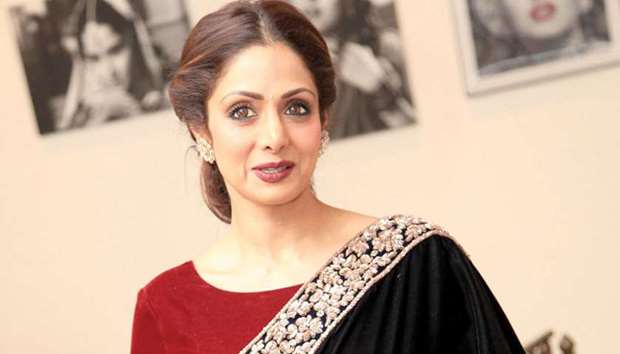
UNPREDICTABILITY OF LIFE: Who knew Sridevi wouldn’t be there to see her daughter take baby steps into a world where she was the uncrowned queen for so many years.