


When Brazil’s President Michel Temer put an Army general in charge of Rio de Janeiro’s security just the week before the last, few people on the streets complained.
The latest wave of violence in this crime-prone city reflects the economic malaise that has come with recession and hinders its recovery. It is particularly frustrating because Rio appeared to have made a lasting breakthrough in containing crime, much like New York City did in the 1990s. Pollster Ibope found 83% of Brazilians support the intervention.
“Police are unable to handle the situation so let’s see if the military can bring order to Rio de Janeiro,” said Felicya Oliveira, 31, a restaurant worker who has lost count of the times she’s had to miss work because of shootouts in the shantytown where she lives.
The story behind the surge of violence in Brazil’s postcard city is one of a prolonged economic crisis and fiscal mismanagement that has left the entire state without money to invest in its police, or even to pay salaries. With the homicide rate at its highest since 2009 and a truck being robbed in the state every hour, crime in turn hits businesses and growth. Retailer Magazine Luiza is backing off the state and bond manager Pimco is planning to move its Latin America office to Sao Paulo.
“Certainly today the issue of security is a key factor in improving Rio de Janeiro’s economy,” said Guilherme Merces, chief economist at Rio’s industry group Firjan. “We can’t quantify the whole impact of workers staying home to care for children who can’t go to school, or who can’t commute, nor the loss of investments, but certainly it is a rather high cost.”
While the Brazilian economy as a whole emerged from recession last year with an estimated growth of 1%, Rio’s has contracted by roughly the same amount amid sharp downturns in the services sector and civil construction, recent projections from Firjan and consultancy Tendencias show. Excluding Rio, which accounts for more than a tenth of the nation’s gross domestic product, Latin America’s largest economy would have expanded 1.26%, Firjan estimates.
Soldiers were deployed on February 19 night along motorways that had been plagued by cargo theft, according to Rio’s security secretariat. Television images the next day showed them inspecting vehicles at roadblocks. The operation involved 3,000 soldiers, in addition to police.
Part of Rio’s budgetary woes are due to massive infrastructure spending ahead of the 2014 World Cup and the 2016 Olympics, as well sky-rocketing personnel and pension outlays. At the same time oil prices fell, revenue shrank and a massive corruption scandal at Rio-based oil company Petrobras thwarted expansion plans. Rio’s previous governor has been indicted more than 20 times.
As a result of the state’s downturn, Rio’s services sector shrank twice as much as Brazil’s did last year. Rio lost 92,000 formal jobs in 2017, more than any other state and more than the country as a whole.
“We’ll only win the war on crime by creating jobs,” Rio governor Luiz Fernando Pezao said at an event on February 20. “And we need a strong rebound in economic activity.”
There are some signs of improvement on the horizon, as expanding oil production will help shore up public coffers and financial aid from the federal government allows Rio to pay delayed salaries to its workers. Combined, the measures are expected to provide a boost to government spending and consumption.
“Rio had really bad performance during the recession,” said Camila Saito, an economist at consultancy Tendencias who specialises in regional analyses. “Our preliminary data show it will be among the last ones to emerge from it.”
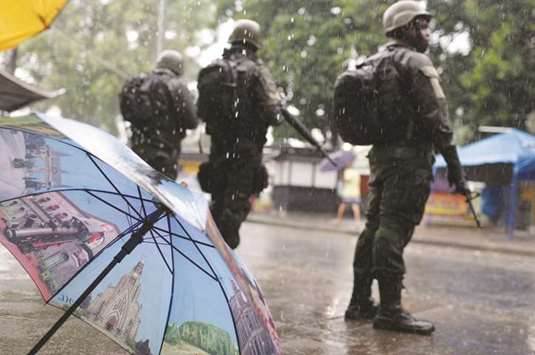
Armed forces members patrol during an operation against drug dealers in Vila Kennedy slum in Rio de Janeiro on Friday. The latest wave of violence in this crime-prone city reflects the economic malaise that has come with recession and hinders its recovery.