


 |
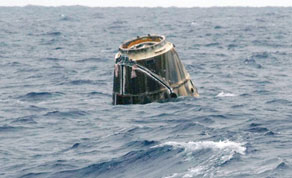
| Space Exploration Technologies’ unmanned Dragon capsule floats in the Pacific Ocean off of Baja California yesterday. The splashdown completes a pioneering mission for commercial firms seeking a major role in space travel |
Riding beneath three parachutes, the bell-shaped capsule ended a nine-day spaceflight with a splashdown about 560 miles (900km) west of Baja California at 11:42am EDT (1542 GMT).
Dragon, built and flown by Space Exploration Technologies, or SpaceX, was the first privately owned spacecraft to reach the $100bn International Space Station, which flies about 240 miles (386km) above Earth.
“Everything passed with flying colors so far,” said Nasa mission commentator Josh Byerly.
The US has been without its own transportation to the station, a project of 15 nations, since its space shuttles were retired last year.
Rather than build and operate a government-owned replacement, Nasa is investing in companies such as SpaceX, with the aim of buying rides for its cargo - and eventually astronauts - on commercial vehicles, a far cheaper alternative.
The successful trial run is expected to clear SpaceX to begin working on its 12-flight, $1.6bn Nasa contract to fly cargo to the station.
A second commercial freighter, built by Orbital Sciences Corp, is expected to debut this year. Orbital has a similar contract valued at $1.9bn to deliver space station cargo.
In yesterday’s operation, astronauts used the station’s 58-ft long (17.7-m) robotic crane to detach the Dragon capsule from its berthing port at 4:07am EDT (0807 GMT) as the spacecraft soared around Earth at 17,500mph (28,164kph).
Dragon was released about 90 minutes later to begin its trip back home.
SpaceX successfully recovered a Dragon capsule from orbit during a previous test flight in December 2010.
““We’ve done it once, but it’s still a very challenging phase of flight,” SpaceX mission director John Couluris told reporters before the splashdown.
“The ability to get to (the) space station on our first time, to not only rendezvous but then to berth, transfer cargo and depart safely are major mission objectives. We would call that mission alone a success,” Couluris said.
Recovery ships owned by American Marine Corp of Los Angeles were standing by to pick up the capsule and bring it back to the Port of Los Angeles, a trip that should take two days.
Dragon will then be taken to a SpaceX processing facility in McGregor, Texas, where it will be unloaded and inspected.
The company’s next test will be to determine if it can speedily return some equipment from the station to Nasa within 48 hours, a practice run for ferrying home precious scientific samples when Dragon begins regular cargo hauls.
The rest of the 1,300lbs (590kg) of gear returning on Dragon is expected to be sent to Nasa within two weeks, said flight director Holly Ridings.
European, Japanese and Russian cargo ships now flying to the station only make one-way trips, leaving Russian Soyuz spacecraft, which are used to transport crew and have little room for cargo, as the only vehicles now flying that return to Earth.