


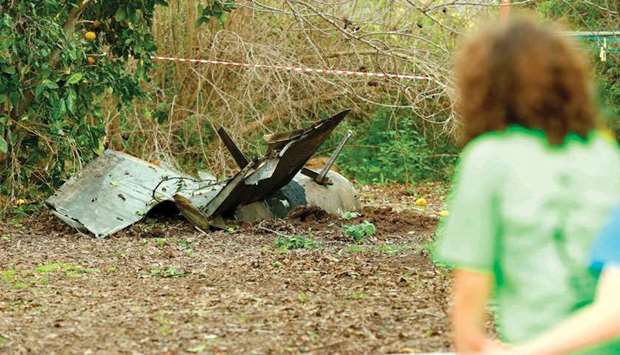
The F-16, one of at least eight Israeli planes despatched in response to what Israel said was a drone’s incursion into its airspace earlier in the day, was hit by a Syrian anti-aircraft missile and crashed in northern Israel, an Israeli official told Reuters.
Both pilots ejected and were injured, one critically.
Israel then launched a second and more intensive air raid, hitting what it said were 12 Iranian and Syrian targets in Syria, including Syrian air defence systems.
Lebanon’s Hezbollah group said the downing of the plane marked the “start of a new strategic phase” which would limit Israel’s ability to enter Syrian airspace. Israel and Syria signalled they were not seeking wider conflict, even as Prime Minister Benjamin Netanyahu rushed to military headquarters in Tel Aviv and the pro-Bashar Assad alliance pledged a strong response to any Israeli “terrorist action”.
“Israel seeks peace, but we will continue to defend ourselves steadfastly against any attack against us or any attempt by Iran to establish itself against us in Syria,” Netanyahu said in a televised statement.
Russia, whose forces began intervening on behalf of Assad in 2015, expressed its concern and urged both sides to exercise restraint and avoid escalation.
Netanyahu said he had spoken by telephone with Russian President Vladimir Putin and that they agreed Israel-Russia military co-ordination in regard to Syria would continue.
A Western diplomat in the region said: “My impression is that it seems to be contained at this point. I don’t think anybody wants to escalate further.”
A Pentagon spokesman said the United States fully supported Israel’s right to defend itself against threats.
Yesterday’s chain of events began at 4:30am (0230 GMT) when an Israeli Apache helicopter shot down an Iranian drone over the northern town of Beit Shean, the Israeli military said.
The drone had been sighted taking off from a base in Syria, and was intercepted after it crossed into Israeli territory, spokesman Lieutenant Colonel Jonathan Conricus said.
Israeli planes then struck an installation in Syria from which, the Israeli military said, the unmanned aircraft had been operated.
The Israeli military released grainy black and white footage of what it said was the drone’s control vehicle in Syria being destroyed.
The F-16 crashed on its return from the mission, coming down in an empty field near Harduf, east of Haifa.
“We heard a big explosion and then sirens. We didn’t know what was happening, we heard helicopters and planes in the air,” said Yosi Sherer, 51, who was staying at a hostel in Beit Shean.
Flights at Tel Aviv’s international airport were briefly halted. The area was quiet by mid-afternoon.
Conricus said missile remnants were found near the crash site: “We don’t know yet if it’s an SA-5 or SA-17, but it’s a Syrian anti-aircraft missile.”
Israel then launched a second bombing raid in Syria.
The pro-Assad military alliance said Israel had attacked a drone base in central Syriabut denied any of its drones had entered Israeli airspace.
Iran rejected the Israeli version of events as “ridiculous”. David Ivry, a former Israeli Air Force chief, told Reuters he believed it was the first time an Israeli F-16 was brought down since Israel began using the jets in the 1980s.
Israel has long maintained air superiority in the region, mounting air strikes in Syria on a regular basis, targeting suspected weapons shipments to Hezbollah.
Hezbollah said in a statement: “Today’s developments mean the old equations have categorically ended.”