


 |
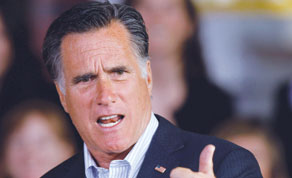
| Mitt Romney holds a town hall-style campaign event at RC Fabricators on Monday in Wilmington, Delaware |
Mitt Romney has effectively won the Republican nod to challenge President Barack Obama in November’s election now that chief rival Rick Santorum has dropped his long-shot White House bid.
Despite an upset victory in the first Republican nominating contest in Iowa in January that led to a surprising showing with victories in 10 more states, Santorum failed to build sufficient momentum to derail frontrunner Romney.
He trailed a distant second in the battle to be the party’s contender aiming to thwart Obama’s hopes of a second term, outspent by Romney’s deep war chest and out-organised by an extensive grassroots network.
Last weekend, the former Pennsylvania senator halted campaigning for four days after his youngest daughter, Bella, who suffers from a rare genetic disorder, was hospitalised again.
Santorum acknowledged on Tuesday that it had been a “difficult weekend,” adding that while Bella was getting better, “it did cause us to think.”
“While this presidential race is over for me and we will suspend our campaign effective today, we are not done fighting,” he said as he pledged to do what he can to help defeat the Democratic incumbent in November.
“We’re going to continue to fight for the Americans who stood up and gave us that air under our wings that allowed us to accomplish things that no political expert would have ever expected,” Santorum said in Gettysburg, Pennsylvania.
In his speech, Santorum did not mention Romney, who may need Santorum’s backing to corral the support of evangelical Christians and core conservatives.
But Santorum spokeswoman Alice Stewart told CNN the pair had a “nice conversation”, and would have “another conversation in the next few days and weeks.”
During an appearance in Delaware, Romney said: “We exchanged our thoughts about going forward, and we both have a great deal of interest in seeing the country taken on a very different path.”
He had earlier congratulated Santorum for being “an able and worthy competitor.”
Santorum quit the race just two weeks before a primary vote in his home state of Pennsylvania, with polls suggesting he could lose to Romney there.
Santorum had already suffered a massive home defeat in 2006, when he was bounced out of the US Senate by a Democratic challenger.
Losing in Pennsylvania a second time would be a disaster for the political brand of a man many experts have said could be laying the groundwork for another run in 2016.
With Romney enjoying a commanding lead in the delegates race that determines the nominee, the Republican establishment had been urging Santorum to step aside and allow the party to coalesce around a single candidate.
The Republican National Committee called Santorum’s decision to drop out “commendable.”
Obama’s campaign manager Jim Messina meanwhile used the opportunity to take aim at Romney, saying: “It’s no surprise that Mitt Romney finally was able to grind down his opponents under an avalanche of negative ads.”
A devout Roman Catholic, Santorum’s far-right views on religion, women and marriage played well with the conservative base, but were alienating the all-important voting bloc of moderates and independents.
Despite being written off early as a largely-unknown candidate, the 53-year-old Santorum had improbable successes in the US South and Midwest.
His staunch opposition to abortion and gay marriage gained traction with heartland evangelicals deeply skeptical of Romney, who served as a moderate governor of liberal Massachusetts.
But Santorum fell too far behind in delegates and ran desperately low on money. On Tuesday he asked supporters to help pay down his campaign’s debt, saying “I cannot be free to focus on helping defeat (Obama) with this burden.”