


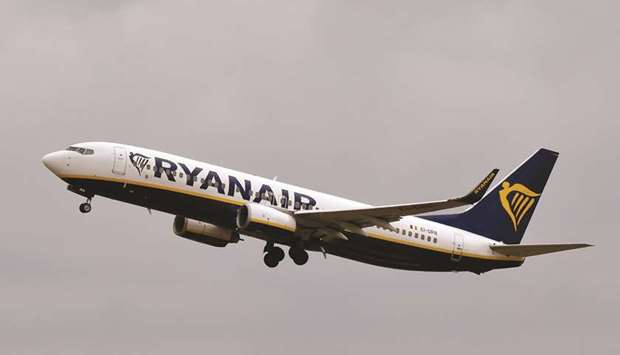
Profit after tax increased to €106mn ($132mn) in the group’s third quarter, or three months to December, from a year earlier, the Dublin-based carrier said in a statement.
Passenger numbers grew 6% to 30.4mn people.
In another boost, the group forecast passenger traffic would climb 8% to 130mn for the full year which ends in March 2018.
That was upgraded from previous guidance of 129mn.
And Ryanair also announced a €750mn share buyback which will begin this month.
“We are pleased to report this...increase in profits during a very challenging third quarter,” said chief executive Michael O’Leary.
Investors seemed unmoved, with Ryanair shares down more than 3% in morning trading in Dublin.
The outspoken boss once more acknowledged Ryanair’s “pilot rostering failure in September”.Ryanair suffered a troubled end to 2017, being forced to cancel 20,000 flights through to March this year, mainly because of botched holiday scheduling for pilots.
The results yesterday came one week after Ryanair signed an agreement to recognise the British Airline Pilots Association (BALPA), reversing its historic hostility towards trade unions.
This after the carrier said that its UK-based pilots had accepted pay increases of up to 20%.
“It became clear in December that a majority of pilots wanted to be represented by unions,” O’Leary said.
“In keeping with our policy to recognise unions when the majority of our people wanted it, we have met pilot unions in Ireland, UK, Spain, Germany, Italy, Portugal, Belgium and France to discuss how we can work with them on behalf of our people.
“We have successfully concluded our first recognition agreement with BALPA in the UK.”
He added: “As we finalise union discussions along similar lines to that agreed in the UK, we expect some localised disruptions and adverse PR so investors should be prepared for same.”
Similar talks will be held with cabin crew unions.
The cancellations fiasco triggered pilots’ demands for better working conditions and representation, with some departing for other carriers.
As a result of pay hikes, staffing costs are set to jump by 45mn euros in the current 2017-2018 year.
And looking ahead to next year, total costs will rise as the fuel bill jumps by more than 300mn euros and the wage bill soars by another 100mn euros.
Hargreaves Lansdown analyst Laith Khalaf said Ryanair was bracing for even more turbulence.
“The dials are moving in the right direction at Ryanair, but Michael O’Leary has switched the fasten seat belt sign on,” said Khalaf.
“The low-cost airline is bracing for a significant increase in staff pay, continued low air fares, and the potential for industrial action as it negotiates with pilot unions across Europe.”
Ryanair shareholders appeared to trade more on the outlook than the results, with the company’s shares falling 3.3%.
Arconic
Arconic Inc’s fourth-quarter earnings and revenue easily topped analysts’ estimates but the specialty metals maker’s forecast for yearly profit and cash flow lagged expectations, sending its shares sliding.
Shares of New York-based Arconic, whose key customers include aircraft makers Boeing and Airbus, fell 7.3% to $26.98 yesterday.
Arconic also said new chief executive Chip Blankenship had begun a review of the company’s business portfolio.
The review would be complete by year-end, the company said, without elaborating.
Arconic expects 2018 earnings of $1.45 to $1.55 per share and a tax rate of 27 to 29%. Analysts on average were expecting earnings of $1.60 per share and a tax rate of 28.4%, according to Thomson Reuters I/B/E/S.
Arconic forecast free cash flow of about $500mn, falling below analysts’ expectations of $534mn.
The outlook came alongside fourth-quarter results that beat Wall Street expectations, helped by higher demand across Arconic’s businesses, including its biggest unit that makes metallic parts for aircraft and aero engines.
Blankenship, a General Electric Co veteran, took the helm in mid-January in a move that pacified Arconic’s biggest shareholder, Elliott Management.
Former CEO Klaus Kleinfeld resigned last April after the company found he sent a letter in “poor judgment” to Elliott, with whom Arconic was embroiled in a proxy war.
Net loss attributable to the company was $727mn in the fourth quarter ended December 31, compared with $1.26bn a year earlier.
Excluding one-time items, Arconic earned 31 cents per share, topping analysts’ estimates of 24 cents.
Arconic recorded $879mn in one-time expenses in the quarter, including the impact of new US tax laws. Sales rose 10% to $3.27bn, ahead of the $3.09bn expected by analysts.
Arconic announced a share buyback of up to $500mn and an early debt reduction of $500mn.
Mitsubishi Corp
Japanese trading house Mitsubishi Corp yesterday lifted its full-year profit forecast to a record high for the second time since November, citing stronger coking coal prices.
The higher-than-expected coal prices also raised Mitsubishi’s recurring profit for the nine months through December 31 by 12% to a record ¥416bn ($3.78bn), mirroring similar record high earnings from trading house peers Mitsui & Co and Itochu Corp. In November, Mitsubishi lifted its profit forecast for the year to March 31 to ¥500bn from ¥450bn, which would be its highest annual profit in a decade.
Yesterday, it further lifted the forecast to ¥540bn, beating a mean estimate of ¥522bn from nine analysts surveyed by Thomson Reuters I/B/E/S.
Mitsubishi also increased its annual dividend outlook from ¥95 per share to 100 yen per share.
Mitsubishi’s chief financial officer Kazuyuki Masu told reporters the price rally in coking coal was partially due to stronger-than-expected demand from China for high-quality coal.
Australian premium coking coal futures in Singapore have surged over 50% from a November low of $174 to $265 a tonne by early January.
They have since come off to around $225 a tonne.
Randgold
African gold miner Randgold doubled its annual dividend after profits rose by 14% in 2017 and said it was fighting to prevent the adoption of a new mining code in the Democratic Republic of Congo (DRC). Randgold, which operates in DRC, Ivory Coast, Mali and Senegal said full year profit rose to $335mn with gold output increasing 5% to 1.315mn ounces, beating guidance.
Its cash cost per ounce fell 3% to $620 while cash reserves rose 39% to $720mn and the company had no debt.
Randgold said its board had proposed a dividend of $2 a share, up from $1 for the previous year.
The company was “well placed to achieve its goal of developing three new projects in the next five years,” it said, predicting production of between 1.30 and 1.35mn ounces in 2018 with a cash cost per ounce of $590-$640.
Randgold also said it was working with the government of the DRC to stop the introduction of a mining code passed by the country’s Senate last month that raises royalties on metals including gold.
“The company believes (the code) will severely limit the growth of the mining industry in the DRC as well as the country’s own economic prospects,” Randgold said in a statement.
It said if the code was enacted without further consultation with miners Randgold would “seek to enforce our rights including those which provide for international arbitration.”
Sandvik
Swedish engineering group Sandvik posted better than expected fourth-quarter core profit yesterday and said demand had been strong across all of its business areas.
The Swedish maker of metal-cutting tools, mining equipment and speciality steels has been riding booming demand for mining gear as well as a sharp rise in general industrial demand throughout most of 2017.
Rivals Atlas Copco and Kennametal had also reported strong demand growth in recent weeks.
Sandvik said that fourth-quarter operating profit excluding one-offs rose to 4.07bn Swedish crowns ($514.92mn). That compared with 3.28bn crowns a year ago and an average forecast of 3.72bn crowns in a Reuters poll of analysts.
The operating profit beat market forecasts in all Sandvik’s business areas, including the speciality steels unit Materials Technology.
“I am very pleased with our diligent focus on cost efficiency in this period of high business activity,” chief executive Bjorn Rosengren said in a statement. “I am particularly pleased with the performance of Sandvik Machining Solutions and Sandvik Mining and Rock Technology.
Order intake at the group rose 15% to 24.1bn crowns, compared with analyst expectations of 23.2bn crowns.
Sandvik shares are up by about 25% in the past year, roughly in line with Atlas Copco and double the gain made by the European industrial sector index.
Tata Motors
Indian carmaker Tata Motors, the owner of Jaguar Land Rover, said yesterday “Brexit uncertainty” in Britain had affected overall quarterly profits as its earnings came in well below analysts’ expectations.
The Mumbai-based manufacturer reported an almost 13-fold increase in quarterly profits year-on-year owing to strong JLR sales in China and a particularly low earnings report 12 months ago due to the effect of a shock Indian banknote ban.
Tata Motors said consolidated net profit for the three months ending December was Rs11.99bn ($187.15mn), up from Rs937.7mn a year earlier when Indians were dealing with the fallout of demonetisation.
A survey of 15 analysts by Bloomberg News had predicted profits of Rs23.5bn this time around.
The car giant said concerns over soaring oil prices and a weaker showing in Western markets, including in Britain, had limited the extent of the increase.
“China and overseas markets were up while the UK, US and European markets were lower, reflecting more challenging conditions with cyclical weakness in the UK and US, increasing diesel uncertainty in the UK and Europe, and Brexit uncertainty in the UK,” Tata Motors said in a statement.
It said Jaguar Land Rover deliveries to North America had declined by 2.4% and by 3.4% to Europe.
But JLR chief executive officer Ralf Speth gave an optimistic forecast for the future.