


Gross domestic product expanded at a 2.6% annual rate also restrained by a modest pace of inventory accumulation, the Commerce Department said in its advance fourth-quarter GDP report yesterday.
That followed a 3.2% growth pace in the third quarter.
Imports, which subtract from GDP growth, increased at their fastest rate in more than seven years.
Rising imports underscore the challenges that the Trump administration faces in its quest to boost annual GDP growth to 3%. A measure of domestic demand jumped at a 4.6% rate, the quickest since the third quarter of 2014, highlighting the economy’s strength.
Final sales to private domestic purchasers rose at a 2.2% pace in the third quarter.
Strong domestic demand is part of a synchronised global rebound that includes the eurozone and Asia.
Demand has also been buoyed by President Donald Trump’s promise of hefty tax cuts, which was fulfilled in December when the Republican-controlled US Congress approved the largest overhaul of the tax code in 30 years. Economists polled by Reuters had forecast the economy growing at a 3.0% pace in the final three months of 2017.
The economy grew 2.3% in 2017, an acceleration from the 1.5% logged in 2016.
Economists expect annual GDP growth will hit the government’s 3% target this year, spurred in part by a weak dollar, rising oil prices and strengthening global economy.
While the corporate income tax rate has been slashed to 21% from 35% and taxes for households have also been lowered, economists see only a modest boost to GDP growth as the fiscal stimulus is coming at a time when the economy is almost at full employment. Prices for US Treasuries pared losses after the data, while the dollar was little changed at lower levels.
US stock index futures were trading higher.
Consumer spending, which accounts for more than two-thirds of US economic activity, increased at a 3.8% rate in the fourth quarter.
That was the quickest pace since the fourth quarter of 2014 and followed a 2.2% rate of growth in the July-September quarter.
Consumer spending is likely to remain supported by rising household wealth, thanks to the stock market rally and higher house prices, tax cuts and firming wage growth as companies compete for workers and some states raise the minimum wage.
Declining savings, however, are a concern.
Savings fell to $384.4bn from $478.3bn in the third quarter.
The saving rate dropped to 2.6% from 3.3% in the prior period. The burst in consumer spending was satiated with imports, which grew at a 13.9% pace in the fourth quarter, the fastest since the third quarter of 2010, offsetting a rise in exports, which is being driven by dollar weakness.
As a result, trade sliced off 1.13 percentage points from GDP growth last quarter, the most in a year, after adding 0.36 percentage point in the third quarter.
Inventory investment also restrained GDP growth in the fourth quarter, subtracting 0.67 percentage point from output after adding 0.79 percentage point to output in the prior period.
With consumer spending accelerating, inflation perked up in the fourth quarter.
The Federal Reserve’s preferred inflation gauge, the personal consumption expenditures (PCE) price index excluding food and energy, rose at a 1.9% rate.
That was the quickest pace in more than a year and followed a 1.3% pace of increase in the third quarter.
Signs of rising inflation together with a tightening labour market could put the Fed on a more aggressive path of interest rate increases than is currently being anticipated, economists say.
The unemployment rate dropped seven-tenths of percentage point last year to a 17-year low of 4.1%. The US central bank has forecast three rate hikes this year, the same number as in 2017.
Business investment in equipment grew at an 11.4% rate, the quickest since the third quarter of 2014 and picking up from the third-quarter’s 10.8% pace.
While spending on equipment is likely to be underpinned in 2018 by the corporate income tax cuts and recent gains in crude oil prices, there are signs that the momentum is slowing.
A second report from the Commerce Department yesterday showed orders for non-defence capital goods excluding aircraft, a closely watched proxy for business spending plans, fell 0.3% in December, the first drop in six months.
Investment in home-building rebounded after contracting for two straight quarters.
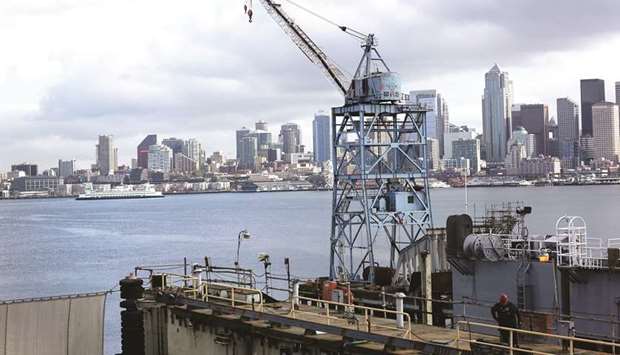
A Washington State Ferry traverses past the city skyline through Puget Sound as seen from the Vigor Shipyard in Seattle. Rising imports underscore the challenges that the Trump administration faces in its quest to boost annual GDP growth to 3%. A measure of domestic demand jumped at a 4.6% rate, the quickest since the third quarter of 2014, highlighting the economy’s strength.