


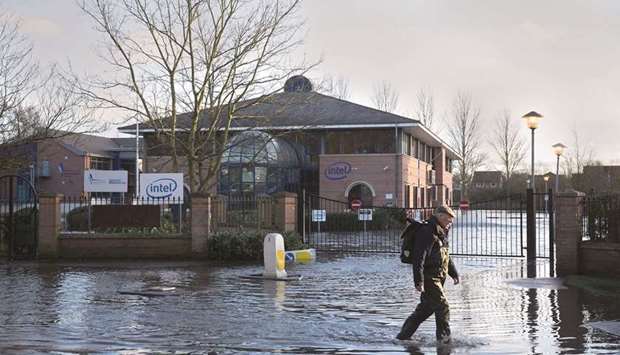
Intel Corp on Thursday gave a bullish forecast and blew past Wall Street profit and revenue expectations for the fourth quarter on the strength of data centre sales, the business it sees as key to its transformation from a PC supplier.
But Intel did acknowledge, for the first time, that the fallout could hurt future results, a concern analysts brushed off.
Intel also boosted its full-year forecast for 2018 above Wall Street expectations, saying it would boost dividends 10% to $1.20 on a yearly basis despite taking a $5.4bn charge related to recent changes in US tax law.
Intel chief executive Brian Krzanich said the company would start shipping chips later this year with “silicon-based changes” to protect against the so-called Spectre and Meltdown security threats.
Revenue from the company’s higher-margin data centre business rose about 20% to $5.58bn, beating the average analyst estimate of $5.13bn, according to Thomson Reuters I/B/E/S.
Revenue from Intel’s PC group hit $9bn for the quarter, a 2% decline from the year before, but ticked up 3% for the year to $34bn.
Intel predicted $65bn in revenue for 2018, well above expectations of a $63.7bn forecast.
In an interview ahead of Intel’s earnings call with investors, chief financial officer Bob Swan said the company sees no “meaningful impact” on corporate earnings as a result of the security vulnerabilities, reiterating an assessment the company made on January 3.The improved dividend and forecasts are important because they are the first signal of how much success Intel has had in containing fallout from the so-called Spectre and Meltdown security flaws that could allow hackers to steal data from computers.
The flaws were disclosed after the close of the currently reported quarter.
The problems affect most modern computing chips but analysts believe that Intel, the No 1 maker of microprocessors, is at greater risk because all the variants of the flaws affect its chips, which have a dominant market position in data centres.
Data centre revenue growth was twice Wall Street expectations, coming at 20% from the year-ago quarter versus investor targets of 10%, said Kevin Cassidy, an analyst at Stifel.
Intel warned in its earnings release that fallout from the discovery of Spectre and Meltdown could hurt future results, as well as customer relationships and the company’s reputation.
It added that publicity over the two vulnerabilities could prompt outside parties to look for other security flaws, which could also harm the company’s business.
Still, GBH Insights analyst Daniel Ives said that Intel investors would heave a sigh of relief.
“The chip vulnerability situation was an overhang over Intel’s shares and this robust quarter, healthy guidance, and underlying business metrics should help investors sleep a bit easier at night.”
Due to the tax charge, the company posted a loss of $687mn, or 15 cents per share, in the fourth quarter ended December 30.
Excluding items, the chip maker earned $1.08 per share.
Total revenue rose 4.1% to $17.05bn.
Analysts on average were expecting a profit of 86 cents per share on a revenue of $16.34bn, according to Thomson Reuters I/B/E/S.
SSAB
Swedish steelmaker SSAB missed fourth-quarter operating profit forecasts yesterday, weighed down by weak results in North America, and proposed its first dividend since 2012.
SSAB, one of the largest steel plate producers in the United States, said its Americas division was the biggest reason for the shortfall in earnings, although it said there were signs business there was improving.
The company, which generates most of its profits in Europe, said its quarterly operating profit rose to 843mn Swedish crowns ($107mn) from 107mn a year earlier.
That lagged a 1bn crown forecast in a Reuters poll of analysts.
“The heavy plate market in North America deteriorated during the fall, leading to lower realised prices,” SSAB chief executive Martin Lindqvist said.
“Nevertheless, demand picked up towards the end of the year and market prices for heavy plate rose sharply”. SSAB said it expected those higher prices to gradually be reflected in earnings, starting in the first quarter.
While SSAB’s results were “somewhat disappointing”, the miss in the Americas should be looked through as the domestic plate market there has sharply recovered of late, Jefferies said in a research note.
SSAB proposed a dividend of 1 crown per share, its first since 2012, and above the 0.9 crowns forecast by analysts.
The company forecast steel shipments in SSAB Europe and SSAB Americas, which together account for around two thirds of group sales, to be somewhat higher in the current quarter versus the fourth quarter.
Shipments in its Special Steels unit, its second largest, were seen stable.
Intuitive Surgical
Intuitive Surgical Inc said on Thursday it would continue to spend heavily on research and development in 2018, seeking to fend off competition and maintain its dominance in the surgical robotic systems market.
Company executives also forecast profit margins for 2018 below 2017 levels on a call with analysts after Intuitive reported better-than-expected earnings for the fourth quarter.
Excluding a $318mn tax expense, Intuitive reported earnings of $2.54 per share.
The result exceeded analysts’ average estimate by 30 cents, according to Thomson Reuters I/B/E/S.
But investors, who sent the company’s stock up 73% last year and 23% in 2018, may have been expecting a bigger earnings outperformance, said Brandon Henry, an analyst at RBC Capital Markets.
Intuitive has enjoyed a near monopoly in the market for robots used in abdominal surgery since launching its flagship device called da Vinci in 2000.
But the company has ramped up spending on product development in recent months to remain ahead of competition.
The FDA approved Transenterix Inc’s surgical robot for abdominal surgery in October.
The news weighed on Intuitive’s stock price even though the device was not expected to compete directly with da Vinci.
Intuitive said operating expenses rose 16.6% year-over-year to $306.3mn in the fourth quarter ended December 31.
Operating expenses this year will rise 16% to 18% above 2017 levels, as the company continues to invest in emerging markets and new technology including computer-assisted surgery, executives said.
Analysts said the expense forecast was slightly higher than expected.
Intuitive expects a 2018 gross profit margin of 70% to 71.5% of revenue, lower than the 71.9% it recorded in 2017.
“They don’t have big deals on the horizon, and they should be investing internally,” said RBC’s Henry.
The higher spending comes amid strong demand for Intuitive’s surgical robots.
Intuitive shipped 216 da Vinci systems in the quarter, compared with 163 in the prior-year period.
The number of surgical procedures using its products rose about 17% in the fourth quarter.
The company expects the number of procedures to rise 11-15% in 2018.
Reflecting the tax expense, Intuitive reported a net loss of $38.8mn in the quarter, compared with a profit of $204mn a year earlier.
Total revenue rose 17.9% to $892.4mn.
Honeywell
US industrial conglomerate Honeywell International reported a better-than-expected quarterly profit yesterday and raised its 2018 earnings forecast, citing lower tax rates.
The company’s quarterly results were driven by strength across its four major divisions, including aerospace, its biggest business by revenue.
Sales in the unit, which makes engines for aircraft made by Bombardier Inc, Textron Inc and General Dynamics Corp, rose 6.4% to $3.90bn in the fourth quarter ended December 31.
Much of the growth in the aerospace business was driven by its commercial aviation aftermarket division as a rise in travel demand boosted sales of spare parts and services to the airline industry.
Honeywell is also benefiting from increased demand from oil and gas customers in the wake of stabilising oil prices.
Sales in Honeywell’s performance materials and technologies unit, which makes catalysts and adsorbents used in petroleum refining, rose 12.4% to $2.85bn in the quarter.
However, a $3.8bn tax provision pushed the company to book a net loss of $2.41bn, or $3.18 per share, in the latest quarter.
Excluding the tax provision, Honeywell earned $1.85 per share, compared with analysts’ expectations of $1.84, according to Thomson Reuters I/B/E/S.
Revenue rose 8.6% to $10.84bn, topping estimates of $10.75bn.
Honeywell raised its 2018 earnings forecast range to $7.75 to $8.00 per share, compared with $7.55 to $7.80 per share estimated previously.
INTEL