


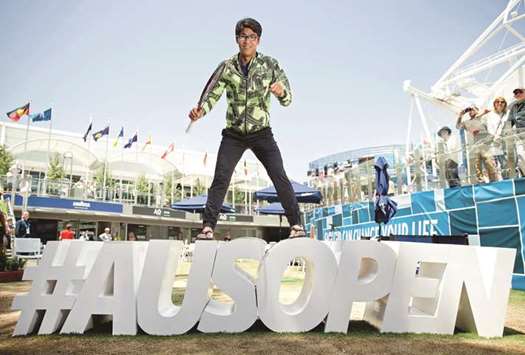
The 21-year-old has enjoyed an amazing run over the last two weeks and if he can get past Federer in Friday’s semi-final, it would ensure a final without the Swiss, Novak Djokovic, Andy Murray or Rafael Nadal for the first time since 2005.
In fact, barring 2014 when Stan Wawrinka won the title, no player apart from the quartet has even been involved in the men’s final at Melbourne Park since 2008.
With Marin Cilic and Kyle Edmund lining up in the other semi-final, that particular dominance is already destined to be broken and Chung denying Federer a place in his 30th grand slam final remains a huge “ if ”. Defending his title as second seed, the 19-times grand slam has yet to give up a set as he has moved through the draw on his mission to match Djokovic’s professional era record of six Melbourne titles.
Djokovic, albeit a Djokovic returning from six months on the sidelines, was world number 58 Chung’s most notable victim on his run to the last four and the manner of his victory caught even Federer’s attention.
“I’m very excited to play Chung. I thought he played an incredible match against Novak,” the 36-year-old said.
“I mean, to beat him here is one of the tough things to do in our sport, I believe. I know that Novak maybe wasn’t at 110 percent, but he was all right. He was giving it a fight till the very end. To close it out, that was mighty impressive.
“I think it’s an interesting match for me. I’ll definitely have to look into how I need to play against him because he has some great qualities, especially defensively, like Novak has.
“One thing I know is I’m going to be playing aggressive. I don’t know how I’m going to do that exactly yet.”
Although Chung won the Next Gen Finals last year, his meteoric rise to the top table of the tennis world is indicated by the fact that he will be bidding to become the first man in a decade to play his first tour final at a grand slam.
His run through the tournament has stunned even him.
“I’m really surprised,” he said. “I make semis, I beat like Sascha (fourth seed Alexander Zverev), Novak, the other good players. I never playing in second week in grand slam, so I’m really surprised.”
Chung finds new tennis audience in Korea
Bespectacled Chung Hyeon’s unprecedented Grand Slam run has brought tennis to new fans in South Korea, but he will need to keep on winning if he wants to trigger a real “boom” in the sport in his home country.
Sales of tennis gear doubled after Chung, 21, beat the little-known but aptly named Tennys Sandgren in the Australian Open quarter-finals, becoming the first Korean to reach the last four at a Grand Slam.
Tennis ranks far behind the likes of baseball or golf in South Korea, where the high cost of equipment and small number of courts in its densely populated
cities have dissuaded many from taking up the game.
But Chung’s quarter-final win drew top television ratings, and media hailed him as “rewriting” the history of tennis in a country which boasts Asia’s fourth-largest economy.
“Wow, I watched a tennis match for the first time because it was the talk of the town but I didn’t know it was such a fun sport,” said one online comment.
Sales of equipment including rackets, bags and clothes at South Korea’s online retailer Gmarket surged 96 percent year-on-year in the 24 hours after Chung’s quarter-final win.
“South Koreans take pride from seeing an underdog South Korean defeating top ranking world players and this is just that,” said Roger Park, a sports marketing professor at Hanyang University.
South Korea has a precedent for excelling at a sport after a trailblazer led the way.
After Pak Se-Ri’s LPGA tour victories from 1998 onwards, South Koreans now dominate women’s golf, occupying four of the top six slots in the current rankings.
And when figure skating sensation Kim Yuna won gold at the 2010 Vancouver Winter Olympics, it led to a flurry of children lacing up their skates and gliding onto the ice.
After beating 12-time Slam-winner Novak Djokovic in straight sets, Chung – who took up the game in an attempt to improve his eyesight – said: “I hope my victory will trigger a tennis boom in South Korea.”
But while the flamboyant Chung has impressed in Melbourne, winning over the Australian crowd, he will need to go a step further if tennis is to catch fire in Korea, experts say.
Chung benefited from a “stroke of luck” when Djokovic fell victim to injury, said Lee Seung-Hwan, a sports marketing professor at Kookmin University. His tournament could also be over on Friday, when he faces 19-time Grand Slam winner Roger Federer.
“Playing in the semi-finals a couple of times won’t put you in the ranks of Kim Yuna or Pak Se-Ri,” said Lee. “You have to become number one to be remembered by South Koreans.”