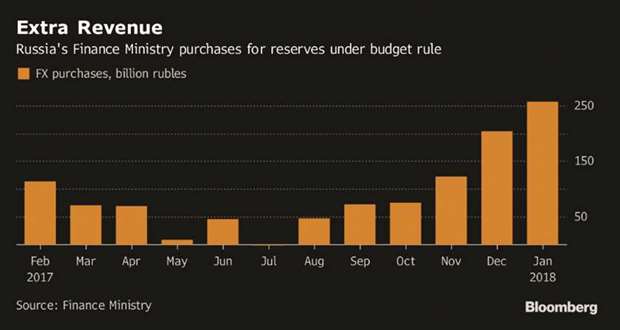
Russia’s Finance Ministry will buy about $4.5bn in foreign currency over the next three weeks, increasing purchases after changes aimed at further limiting the economy’s dependence on oil.
The amount of additional budget revenue earned in January from oil and gas is expected at 257.1bn roubles ($4.5bn) as a result of higher crude prices, the Finance Ministry said on Thursday. Under a so-called budget rule, the entire windfall will be spent on buying foreign currency in the domestic market, with daily purchases at 15.1bn roubles from January 15 to February 6, it said in a statement.
The operations will help insulate the economy from the ups and downs in crude and shield the rouble’s exchange rate from volatility. The government is absorbing all revenue earned when Russia’s Urals export blend is above $40 a barrel, channelling the excess income into its sovereign wealth fund.
Starting this year, the Finance Ministry will use a formula that effectively removes the impact of the exchange rate and increases the volume of foreign currency to be acquired. It bought 841.8bn roubles in 2017, which will be transferred to the National Wellbeing Fund in 2018, according to Finance Minister Anton Siluanov.
“This policy will be continued in 2018,” he said on Wednesday. “If oil prices and the exchange rate remain at the current level, we’ll be able not only to spend reserves, but also to boost the National Wellbeing Fund.”
Foreign-currency purchases will total about 2tn roubles this year if prices for crude average $54-$55 a barrel, and rise to about 2.8tn roubles if oil is around $60, Siluanov said last month.
Benchmark Brent – which trades at a small premium to Urals – was little changed at $69.22 a barrel on the ICE Futures Europe exchange after topping $70 a barrel in London on Thursday for the first time in three years. The rouble retreated 0.2% to 56.5250 against the dollar as of 1pm in Moscow. It’s up almost 2% this year.
“With the current oil price, the impact of foreign-currency purchases won’t have a significant impact on the rouble,” said Vladimir Miklashevsky, senior economist at Danske Bank A/S in Helsinki. “But if crude prices rise, purchases may become more aggressive.”