


South African regulators are scrutinising trades prompted by speculation that Viceroy Research will release a negative report about one of the country’s stocks, which caused some shares to crash more than 20%.
The Financial Services Board is working with the Johannesburg Stock Exchange to review trading activity and determine whether a formal probe is warranted, Tembisa Marele, a spokeswoman for the Pretoria-based FSB said in an e-mailed response to questions. The FSB’s mandate includes probing insider trading, price manipulation and false reporting.
Shares of some of the country’s largest real estate investment trusts fell by a record yesterday as talk swirled that one of them will be targeted in Viceroy’s next research report. Aspen Pharmacare Holdings Ltd, Africa’s biggest drugmaker, plunged on January 9 amid rumours it is in Viceroy’s sights. The stock has since recovered all those losses after Aspen chief executive officer Stephen Saad came out in defence of his company, saying its earnings are transparent.
Very little is known about Viceroy, which refers to itself as a US-based short-seller, or the people behind it, who describe themselves on their website as “a group of individuals who see the world differently.” Viceroy gained attention in South Africa after releasing a report detailing some of Steinhoff International Holdings NV’s woes shortly after the retailer said it was investigating accounting irregularities that caused most of its value to be wiped out.
“Viceroy encourages people not to speculate on the identity of any companies we are researching and we advise caution in trading on gossip,” the company said in a statement, issued from a Gmail account. “Viceroy complies with the laws and does not release research or discuss our focus prior to publication.”
The 21-member FTSE/JSE Africa Listed Property Index plunged the most since December 2015 before paring losses to trade 2.1% down by 2pm in Johannesburg yesterday. Resilient REIT Ltd plummeted by record 22% before trading 3.3% lower. Greenbay Properties Ltd, Fortress REIT Ltd-B and Nepi Rockcastle all recovered from declines of as much as 20%.
“Nobody knows who Viceroy is,” said David Shapiro, deputy chairman of Sasfin Wealth in Johannesburg. “They’re an anonymous bunch of people; they may be absolutely 100% right, on the other hand they could be 100% wrong.”
Traders are taking advantage of the rumours “and plugging the market without really applying common sense,” he said. The real estate counters “are overvalued, but so is our market. We’ve got a hothouse of debt. Everyone is now panicking.”
Steinhoff has lost more than 80% of its value since the owner of France’s Conforama, Mattress Firm in the US and Pep in South Africa said there were anomalies with its numbers on December 5.
“The market is going through each company with a fine-tooth comb at the moment,” said Petri Redelinghuys, founder of Johannesburg-based stockbroker Herenya Capital Advisors. “Following the Steinhoff collapse no one wants to be caught on the wrong side of that. It’s actually insane what’s going on with a company that can fall as much as 20% and then recover within three or four hours.”
Following the stock’s initial steep decline, Fortress said yesterday it anticipates increasing its interim dividend for each B share by as much as 15.5%. “Trading in the current financial year has been consistent with the prospects previously communicated to shareholders,” the property company said.
A representative for Resilient said its stock was moving on market speculation of the possible Viceroy report, adding that the real estate investment trust hasn’t been contacted by the research firm. Calls to Greenbay’s offices weren’t immediately answered. Nepi chief financial officer Mirela Covasa said the company is looking into why its shares are declining. -With assistance from Janice Kew.
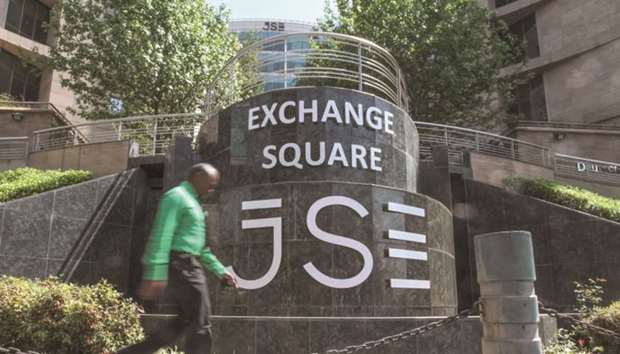
A pedestrian passes the entrance to the Johannesburg Stock Exchange (JSE) in Sandton, South Africa (file). South African regulators are scrutinising trades prompted by speculation that Viceroy Research will release a negative report about one of the country’s stocks, which caused some shares to crash more than 20%.