


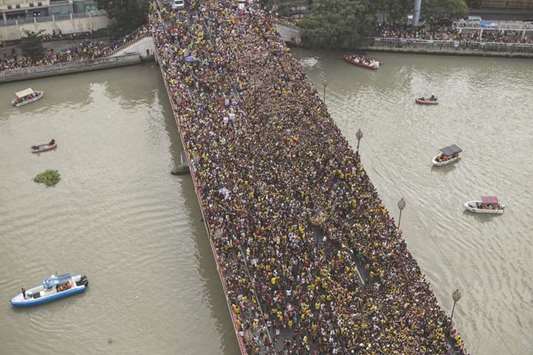
Millions of barefoot devotees yesterday joined the largest religious procession in the predominantly Catholic Philippines.
More than 6,000 police officers and soldiers were deployed to secure the feast of the Black Nazarene, which is highlighted by a day-long procession that traverses nearly 7km in downtown Manila.
The devotees, mostly wearing maroon and yellow shirts, jostled their way through a frenzied crowd to reach the carriage carrying the statue.
They waved towels or handkerchiefs and chanted “Viva, Viva, Viva!”
More than 2.5mn people were estimated to have taken part in the procession, including hundreds of thousands who stayed overnight in a Manila park where the statue had been displayed since Monday.
Manila Archbishop Cardinal Luis Antonio Tagle led a mass before the start of the procession from Luneta Park to the Minor Basilica of the Black Nazarene in the district of Quiapo.
“Let us look at Christ and hold on to him as we go through our own (journey) in life,” he said in his homily. “If we lose our way, he will be the one to lead us in the way to the Father.”
Celeste Santos, a 45-year-old mother of four children, said she started her devotion to the Black Nazarene when she was still a teenager and her mother brought her to the annual festival.
“My mama passed away two years ago, but my children and I are continuing the tradition for our family,” she said. “I only wish for good health and safety for all my children.”
Last year, the procession took 22 hours, but organisers said it was moving faster this year.
More than 1,000 people have been treated for high blood pressure, dizziness, fractures and other injuries in the first 11 hours of the procession, according to the Philippine Red Cross and the Department of Health.
Authorities imposed bans on liquor sales and carrying of firearms among civilians in Manila City, while telecommunication companies advised customers they would temporarily cut off service in the area as part of security precautions.
The Black Nazarene, which is a wooden statue, is believed to have been brought from Mexico to Manila in 1606 by Spanish missionaries.
The ship that carried it caught fire, but the charred statue survived and was named the Black Nazarene.
The procession commemorates the transfer of the statue from Lunet Park to the church in Quiapo in 1787.
More than 80% of the Philippines’ estimated 100mn population are Roman Catholic.
Devotees carry the statue of the Black Nazarene to the carriage at the start of the annual procession in Manila, yesterday.