


“Almost 17,000 workers are currently engaged at our project sites, all helping bring the 2022 FIFA World Cup to life,” a report on sc.qa said. “It’s the duty of the Supreme Committee for Delivery & Legacy and the Workers’ Welfare Department (WWD) to ensure that their health, safety and general wellbeing are all protected during their time on our programme.”
The first half of the year “demonstrated the SC’s commitment to transparency”, as it continued its work with Building & Wood Workers’ International (BWI) and its external monitor, Impactt Ltd, the report noted.
“Our work with BWI saw six inspections take place during 2017: at Al Wakrah Stadium, Al Bayt Stadium-Al Khor City, Al Rayyan Stadium, Qatar Foundation Stadium and multiple accommodation sites. The developing partnership with BWI, through the Joint Working Group (JWG) made up of both SC and BWI representatives, identified a series of health and safety issues that we were able to address and enhance,” the SC said.
Throughout the process, BWI’s team of experts offered feedback in a number of areas, including suggestions to strengthen grievance mechanisms and enhance occupational health and safety. The SC has stressed that all suggestions will be addressed, and training of worker representatives will take place as the co-operation agreement with BWI continues for a second year in 2018.
In other examples of transparency, and following two quarters of initial and follow-up audits, Impactt released its first annual report in April. The report highlighted the progress made to date and laid out a roadmap for improvements and enhancements, which the SC said it was actively working on for implementation. The SC also released its own Progress Report in June, which gave its perspective on the successes and challenges of the previous year. 2018 will see the publication of these reports again, in addition to an Annual Report by the BWI JWG.
In terms of outreach, one of the key initiatives launched by the SC in 2017 was the Nutrition Programme with Weill Cornell Medicine-Qatar. A “first-of-its-kind” initiative in the Gulf region, the programme was designed to identify prevalent health risks among SC workers and raise awareness of the importance of health and nutrition among workers and contractors.
The first phase tested more than 1,000 workers for key health issues, and the results were used to shape phases two and three, which would focus respectively on training and awareness for workers and contractors, and proposing menu changes to caterers in order to improve diets throughout 2018, the report explained.
During this period, the SC also recognised the need to enhance the skills of its workers to protect their safety and bolster their skills for both current and future employment. “To achieve this, we partnered with Qatar International Safety Centre and began delivering bespoke training to our workers in late 2017. The initial focus has been on workers’ welfare induction, while the first quarter of 2018 will cover emergency medical training and occupational health training, among other topics,” the SC added.
The emergency medical training is largely based on the findings of a recent emergency medical response assessment carried out by the SC’s health and safety team across all sites and accommodations. This was initiated to identify health and safety gaps and offer solutions that could immediately make a difference to the level of healthcare on the SC projects. The assessment included baseline health screenings for 12,000 workers, in addition to assessments of medical staff and facilities.
“The findings were used first and foremost to ensure that workers deemed as high-risk receive immediate medical attention, and secondly to develop a health and safety roadmap, which we will continue to implement throughout the course of 2018,” the report pointed out.
In a similar vein of health and safety enhancements, the SC said it worked to identify and roll out innovative cooling technologies across its projects. The SC piloted ‘state-of-the-art’ technologies at the Al Wakrah Stadium and Lusail Stadium sites to assess if these solutions would benefit workers during hotter times of the year. “The findings were very positive, and as a result cooling towels and vests were distributed to approximately 10,000 workers on our programme. We are hopeful that 2018 will see further enhancements in this area, with the help of local research and development partners,” it continued.
Throughout this time, the SC continued to execute its comprehensive compliance and audit programme. It developed a ‘robust’ Compliance & Audit Plan to help enforce its Workers’ Welfare Standards and ensure that workers are protected all the way through from recruitment to repatriation. Implementation of this plan resulted in 8,800 hours spent on accommodation inspections and ethical recruitment audits throughout the year, with 10% of the workforce being interviewed.
Another major achievement in this area was the institution of the pre-Other Contracting Parties (OCPs) approval, a process that allows the WWD to audit OCPs and approve or reject them before a main contractor mobilises them on any SC project. This “greatly enhanced the compliance programme” and would continue to do so in the new year, the SC said.
“Our compliance efforts also addressed a key issue – the amplification of workers’ voices. Throughout 2017, we launched a dedicated grievance hotline to receive and address workers’ issues and concerns. We also worked on enhancing existing Workers’ Welfare Forums (WWFs), and on instituting new ones where needed. There are currently 52 active WWFs across the programme. The forums saw worker representative elections being carried out across multiple sites, with many more due in 2018, when we will continue to expand and enhance the mechanisms available to our workers to make their voices heard,” the report noted.
The SC stressed that it looked forward to continuing the projects it launched in 2017, and rolling out further initiatives, in 2018 to address the challenges and gaps identified along the way.
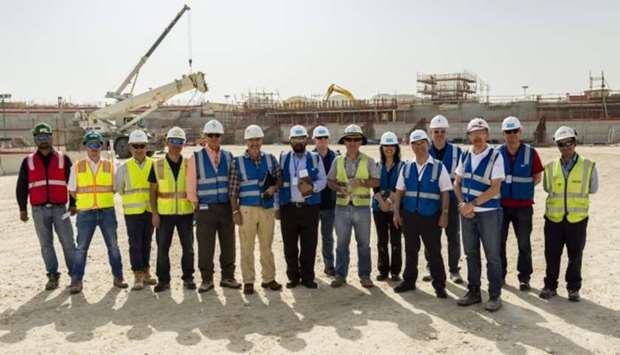
Almost 17,000 workers are currently engaged at 2022 FIFA World Cup project sites.
The past 12 months have seen a “huge focus on outreach and innovation” to contribute to achieving the welfare of workers engaged in its projects, the Supreme Committee for Delivery & Legacy (SC) has said.