


 |
|
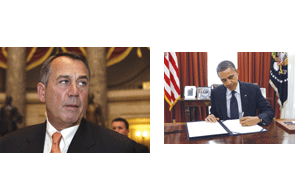
Boehner: I think we waged a good fight. Obama signing the payroll tax cut extension yesterday in the Oval Office of the White House |
Both the Senate and the House of Representatives, by voice votes in chambers nearly emptied for the holidays, passed a $33bn measure to keep the payroll tax rate at 4.2% until the end of February.
It had been slated to increase after December 31 to 6.2%.
It also means that 2mn Americans will keep unemployment benefits that were due to expire at the end of the year.
Cuts in payments to doctors who treat patients in the government-backed Medicare health insurance programme for the elderly were also postponed, under the measures.
The temporary fix lets lawmakers draw down the curtain, for now, on weeks of partisan deadlock that in the end produced only another inconclusive truce in a debate over taxes and spending that is set to rage straight through 2012.
The fix gives President Barack Obama and the Democrats a political win over Republicans.
The 2012 election cycle is about to kick off with the January 3 Iowa Republican presidential caucus, but a long road lies ahead until voters go to polls in November.
The showdown over a payroll tax cut extension worth about $40 per paycheque to average Americans was the latest fierce showdown for control of power in polarised Washington ahead of Obama’s 2012 re-election race.
“Because of this agreement, every working American will keep his or her tax cut – about $1,000 for the average family,” Obama said. “That’s about $40 in every paycheque.”
“This is good news, just in time for the holidays,” Obama said in a written statement and praised Americans who had flooded the White House website and Twitter with complaints that they would lose their payroll tax cut.
“I want to thank every American who raised your voice to remind folks in this town what this debate was all about,” Obama said. “It was about you. And today, your voices made all the difference.”
House Republicans had been pilloried by Democrats, elements of the conservative media and luminaries from their own side for blocking the bipartisan Senate compromise.
Republican Senate Minority leader Mitch McConnell had weighed in on Thursday, sketching the details of the possible compromise, in an intervention that may have been decisive.
As a complex political chess game unfolded in Washington, Obama had put off plans to head to the surf and sands of Hawaii to join his wife and daughters for their annual end-of-year vacation.
Obama had earlier fumed at the fact that Republicans and Democrats agreed that passing a payroll tax cut was necessary, but were unable to agree on the length of the extension.
“Has this place become so dysfunctional that even when people agree with things, we can’t do it?
“It doesn’t make any sense. Enough is enough,” the president said.
The Democratic-led Senate voted for a two-month extension of the payroll tax holiday in a compromise at the weekend, but the bill was blocked by the Republican-led House which wanted a one-year extension.
House Speaker John Boehner, the top US Republican, yielded to pressure from Democrats and his party and agreed, with minor changes, to allow a vote on the extension bill passed by the Senate last week with bipartisan support.
“Sometimes, it’s hard to do the right thing and sometimes, it’s politically difficult to do the right thing,” Boehner said.
“(It) may not have been the politically the smartest thing in the world, but let me tell you what: I think our members waged a good fight.”
The new compromise will also see Democratic Senate leader Harry Reid appoint negotiators to work on a one-year extension to the payroll tax break, which was sought by the House.
The deal means the payroll tax deduction, which is separate from income taxes and funds the US retirement system, will remain at 4.2% instead of rising to 6.2% on January 1.
Democratic Representative Chris Van Hollen said yesterday that the two parties remained far apart on how to pay for a full-year fix.
“I heard Eric Cantor (the No. 2 Republican in the House) at one point say the parties are really close on the one-year deal. That’s just not the case,” Van Hollen told MSNBC.