


Wall Street is holding its breath for the rekindling of mergers and acquisitions across the biotechnology and pharmaceutical sector after 2017 led to a pause in dea-making. Tax reform, particularly a lower levy on US companies’ overseas cash, may be the key to driving the return of M&A in 2018. “Choppy waters will likely continue, unless M&A saves the day,” RBC analysts led by Brian Abrahams wrote in their look ahead to next year.
Goldman analysts led by Jami Rubin see a lower tax rate on repatriated cash, yielding about $160bn across the healthcare sector. That extra cash may be used for “aggressive capital allocation”; in addition to M&A, that cash could also be spent on buybacks and dividends, or a combination of the three Goldman predicted.
Pfizer, instead of announcing a new mega-deal, is ending the year by starting a $10bn share buyback programme and an increased dividend. Still, some analysts are hopeful after Roche’s $1.7bn bid for Ignyta. JPMorgan’s January healthcare conference in San Francisco is often a platform for partnerships and deals to be announced.
Concern also abound that Democratic wins in midterm elections may once again raise a rallying cry around drug pricing reform, driving a return to uncertainty in the sector similar to years past when Hillary Clinton’s tweets rocked the market.
RBC Capital: “Stocks – as well as investor sentiment – continue to whipsaw wildly from one day to the next, making it virtually impossible to see which direction will hold as we move into 2018”.
Tax reform may give biotech sector a boost in the first half of the year, although there may be more focus on partnering over traditional M&A, which may frustrate investors and lead to more exits.
Earnings expectations may be a challenge and could drive investor money toward small- to mid-cap companies, if not out of biotech entirely. Key catalysts that may drive sector sentiment include results from Incyte Corp in melanoma, Alexion Pharmaceuticals in a very rare blood disorder known as paroxysmal nocturnal haemoglobinuria, and Biogen data in Alzheimer’s.
Goldman Sachs: “We advocate selectivity going into 2018 following a solid rebound for health care in 2017,” possibility of Democratic wins in midterm elections may “add uncertainty” as the debate over drug pricing reform could reignite under Democrats.
Sector growth expectations “are now measured” and likely to be no better than the broader market; US equity strategist calls for “an earnings-driven bull market,” hinged on tax reform, continuing in 2018. “Seeing early signs of a bottoming of the beleaguered generic sector with commentary on rationalisation of manufacturing capacity and portfolios from the largest players” including Teva Pharmaceutical Industries and Novartis.
New ideas for conviction list; BioMarin Pharmaceutical, Alnylam Pharmaceuticals and Hologic.
Morgan Stanley: “We see opportunity in high conviction ideas given limited 2018 investor conviction. Potential M&A from tax reform is balanced by a potential increase in political noise, but high sector innovation remains encouraging.”
Amgen may benefit the most from tax reform, bringing back about $39bn from overseas cash; Biogen, Celgene Corp, Alexion Pharmaceuticals and Gilead Sciences are the most likely to make deals to pad their pipelines.
There’s a lack of clinical catalysts for large-caps next year, focus for Gilead likely on reimbursement complications and patient demand for its CAR-T therapy while Vertex Pharmaceuticals investors are awaiting the company’s triple-drug cocktail for cystic fibrosis to reach the market.
Among small-to mid-caps with potential catalysts that may move shares 20% or more are: Biohaven Pharmaceutical Holding Company with late-stage migraine therapy results in 1Q, Portola Pharmaceuticals with regulatory approval decisions on Bevyxxa manufacturing and AndexXa, Global Blood Therapeutics on initial data from “Hope” study in first half and DBV Technologies with an update on the regulatory path forward for its peanut allergy treatment, Viaskin.
Jefferies: 2018 viewed as a “repair year” ahead of large cap biotech new product cycle in 2019. Key catalysts ahead include; Gilead results for its autoimmune drug with Galapagos and in a liver disease known as NASH; Celgene data for ozanimod in ulcerative colitis; Biogen’s Alzheimer’s data and results and commercial drug launch for Vertex’s triple combo. Celgene may use its $8bn overseas cash and $50bn in free cash flow to buy more assets in the coming years.
JPMorgan: M&A will be key for generalists to return to the biotech sector with repatriation of overseas cash a potential trigger; “if M&A fails to materialise, selectivity may again become increasingly important”. Sees estimates for earnings “broadly achievable” after a rough third quarter for biotech bellwethers. Clinical catalysts are “an omnipresent risk”.
Top long ideas include Celgene, Puma Biotech while shorts include Amgen and Tesaro.
Credit Suisse: “We believe industry consolidation is inevitable but our caution is driven by the fact that we can’t predict when this important trend will play out.” Large caps viewed as “better source” of investments ideas than mega-caps.
Top picks for next year are Incyte Corp, Vertex, Sarepta Therapeutics, Puma Biotechnology, and Tesaro.
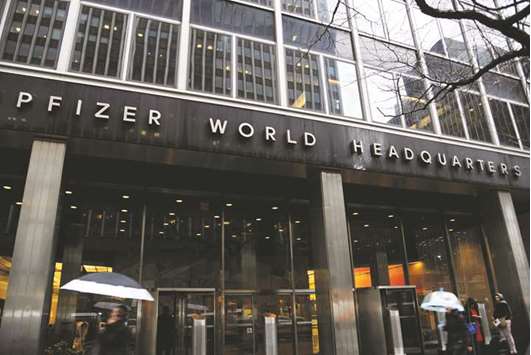
Pedestrians walk past Pfizer headquarters in New York. Pfizer, instead of announcing a new mega-deal, is ending the year by starting a $10bn share buyback programme and an increased dividend.