


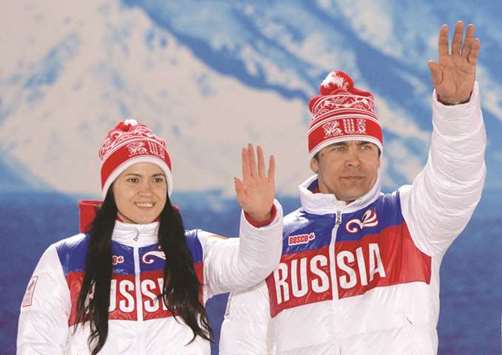
Demchenko and Ivanova were punished along with two speed skaters, three cross country skiers, two bobsledders and two ice hockey players. These latest IOC sanctions brings to 43 the number of Russians caught out by the Oswald Commission into doping at Sochi with three cases pending. “As some investigations are still ongoing (notably the forensic analysis of the bottles), it cannot be excluded that there might be new elements that would justify opening further new cases and holding more hearings,” the IOC said in a statement.
The raft of punishments have seen Russia lose top spot in the Sochi medals table having been stripped of 13 of their original 33 medals for cheating, slipping down to fourth overall behind Norway, Canada and the United States.
Russia has been banned from taking part at next year’s Winter Olympics in Pyeongchang, South Korea due to this widespread doping. However, athletes who prove themselves to be clean have been told by the IOC they can compete under strict conditions, and under a neutral flag. Demchenko, who was world luge champion in 2005 before becoming head of the Russian national team, also won a silver medal at the 2006 Winter Olympics in Turin. Also banned yesterday, were ice hockey players Tatiana Burina and Anna Shchukina, cross-country skiers Nikita Kryukov, Alexander Bessmertnykh and Natalia Mateeva.
Bessmertnykh had already been stripped of his silver medal from the 4x10km relay following the disqualification of teammate Alexander Legkov. Bobsledders Liudmila Udobkina and Maxim Belugin and speed skaters Ivan Skobrev and Artem Kuznetsov also suffered disqualification. Of the 43 Russians so far banished as a result of the Oswald probe, 22 have lodged appeals at the Court of Arbitration for Sport (CAS). The first of these appeals will take place in January but an exact date has yet to be fixed, a CAS spokesman said.
The Russian doping fiasco came to light after the damning World Anti-Doping Agency-sponsored McLaren report deemed the country to have set up an elaborate doping programme involving the manipulation of drug test samples. Mounting evidence has indicated that the scheme involved senior government officials, including from the Russian sports ministry, with help from secret state agents.
S Korea opens high-speed line to Winter Olympic venues
Emblazoned with a tiger and a bear — the mascots of the 2018 Winter Olympics and Paralympics — a blue and white high-speed train rolled out of Seoul station yesterday as a new line to the venues opened to the public. The railway cuts travel times significantly, reaching Jinbu — the station for snow sports at the Pyeongchang Games — in one hour and 20 minutes from Seoul, and another 16 minutes to Gangneung on the east coast, where ice events will take place.During the Games 51 trains will operate a day on the 278-kilometre line, which starts from Incheon airport southwest of the capital, with a total capacity of 20,910 passengers. The new railway is part of South Korea’s KTX network. Previously travellers from Seoul to Pyeongchang have mostly had to go by road — around a three hour drive. Many other Olympics and major sporting events have had trouble preparing infrastructure, with dashes to complete stadiums and other facilities in time, but in South Korea the process has been highly competent.
On Thursday, marking 50 days to go before the opening ceremony, the Games’ chief organiser Lee Hee-beom said: “We are very proud of what we have created in Pyeongchang and the efficiency with which the venues and infrastructure have been built. We have worked hard over the last seven years to make our dream a reality and now the international sports festival is within reach for us all.”
Even so the Games remain overshadowed by tensions with the nuclear-armed North, and the Russian national team has been banned over accusations of state-sponsored doping. “The Olympics is a big event and if an international problem happens it will worry many people,” Seoul resident Ahn Ju-young said at the station Friday before boarding the train.
“As a South Korean, I really hope there aren’t any problems,” she added. Ticket sales have picked up, with 586,300 tickets sold as of December 10 — the latest figures available from the organisers — or 49.7 % of the total 1.18mn available.
Another passenger, Kang Jae-Hoon, had no plans to go to the Games himself but hoped many people would use the new train line. He regularly goes to Gangneung to surf, he said, but transport “has always been difficult”.