


In preparation for the upcoming season of the World Rugby Women’s Sevens Series, the French national rugby union team have recently concluded a week-long training camp in Aspetar where they have benefited from Aspetar’s innovative state-of-the-art Altitude Rooms, the first fully-integrated dormitory of its kind in the world.
The women’s rugby team visited Aspetar to prepare for the World Rugby Women’s Sevens Series, a five-round tournament running from November until June. The annual event attracts fans from all over the world who enjoy the sprints and sprawls of sevens rugby.
Aspetar’s recently-renovated altitude dormitory is a purpose built normobaric hypoxic facility that utilises a filtration system to reduce the oxygen concentration in the air. Hypoxic training is one of the well-known practices utilised to enhance athlete performance during major competitions.
Designed specifically for elite training camps, the facility allows athletes to improve endurance by stimulating the body to increase production of red blood cells, thus increasing the proportion of oxygen in the blood. The rooms can replicate an altitude range of 500m to 5,500m, enabling athletes to “live high, train low” by replicating hide altitude training from sea-level. The facility also uses advanced technology that enables conditions to be monitored remotely from anywhere in the world and can house up to 50 athletes.
Speaking about Aspetar’s training methodology, Dr Olivier Girard, Research Scientist at Aspetar, said: “In 2013, Aspetar hosted the first Altitude Training and Team Sports Conference, bringing together more than 15 experts and 200 attendees. Since then, the conference has become a staple of Aspetar’s events calendar. We wanted to experiment with a new altitude training programme with the French Rugby Team to prepare them for the new rugby season. We usually go for a simulated altitude of 3km when training visiting sports teams, but this time we went for a simulated altitude of 5km, across four training sessions in the hypoxic chambers.
“This hyper-intensive training will help maximise results and improve their performance as much as possible over a short period of time. The training included the use of a special treadmill that’s only available in Qatar and one other country. We use this to measure the ground reaction force for every step made against the ground. We then benchmark their performance against that of other visitors.
“We also used a new assessment methodology that focuses on a flow-mediated dilation test [the most commonly utilised non-invasive assessment of vascular functions in people]. To my knowledge, this is the first time that this sort of comprehensive assessment has been conducted for elite athletes under one roof, and we are delighted to bring cutting-edge medical and sports science support to elite teams which help to give them a competitive edge.”
Meanwhile, Dr Sebastien Racinais, Head of Research Athlete Health and Performance in Aspetar, praised their collaborations with various French sporting organisations, saying: “We [Aspetar] have been collaborating with the French Rugby Federation for six years now. The aim of this collaboration is to develop innovative training methodologies. This partnership has recently been strengthened by the signing of another Memorandum of Understanding between the French National Institute of Sport and Aspire Zone Foundation. They first came here in 2014 before the Winter Olympics to benefit from altitude facilities where we can imitate any altitude in the world.”
He added, “This collaboration helps Aspetar collect data from elite athletes which we can use to learn more about the training and then apply it to other athletes who come here from other countries.”
Commenting on their stay in Aspetar, Fanny Horta, captain of the French team, said: “We came here two years ago and at that time we stayed in a hotel nearby. Being here in the hospital allowed us to be closer to the training pitches, and it also helped in terms of time management and the ability to have a really complete day of training because we have everything here in one place: the Gym, the pool, the training pitch, the medical staff, and the fitness coaches at our disposal.”
Aspetar has become the preferred training camp destination for elite international teams and athletes. Aspetar will host the French men’s national rugby team on December 27th. Meanwhile, Aspire Zone, Aspetar’s parent organisation, is currently hosting the French athletic team, comprising prominent athletes including Kevin Mayer, the 2017 Decathlon World Champion.
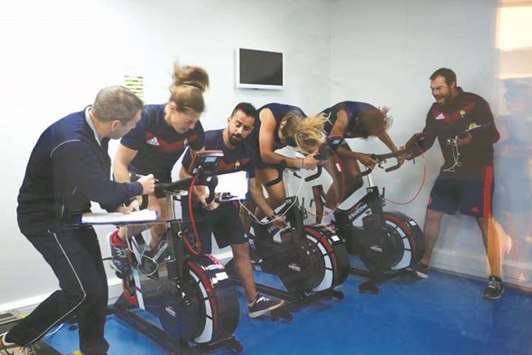
France’s women’s rugby team train at the Aspetar in Doha.