


 |
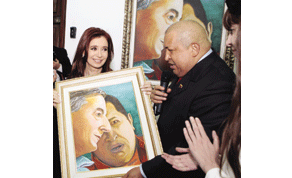
| Chavez gifts to Fernandez a copy of painting he drew, depicting her late husband, former Argentinian president Nestor Kirchner, and him, at Miraflores Palace in Caracas |
The inaugural meeting of the 33-member Community of Latin American and Caribbean States (CELAC), which pointedly does not include the US or Canada, is his first big moment back on the world stage since he had cancer surgery in June.
The 57-year-old, who aims to win re-election next October in the Opec (Organisation of Petroleum Exporting Countries) nation, warmly greeted fellow leaders including Dilma Rousseff of Brazil, Argentina’s Cristina Fernandez and Cuba’s Raul Castro.
“As the years go by, CELAC is going to leave behind the old and worn-out OAS,” Chavez told reporters. “The OAS is a forum that was always manipulated by the US ... it’s a body made ragged by its age and drained by the years, and it’s very far from the spirit of our people and the integration needed in Latin America.”
Chavez even showed off his artistic skills, making Fernandez shed a tear when he presented her with a large painting he had done depicting him with her late husband.
“It is the best picture I’ve ever painted,” he said.
The countries of CELAC have nearly 600mn people and comprise the world’s number one food exporter.
They have a combined GDP of about $6tn – roughly a third of the combined output of the US and Canada.
Cuba, suspended from the OAS in 1962, is a CELAC member.
Analysts say the new body demonstrates the wish of Latin America and the Caribbean to move out of the shadow of Washington and take greater control of their own affairs.
“This has been aided by a progressive disengagement from the region by the US since the end of the Cold War, allowing other countries – most notably China – to increase their footprint in primarily economic, but also political, terms,” said Robert Munks of global think tank IHS Janes.
The December 2-3 summit was meant to be held six months ago to coincide with Venezuela’s 200th anniversary of independence.
But it was called off at the last minute as Chavez recovered in Havana following surgery to remove a baseball-sized tumour.
Chavez says that he is cured after four chemotherapy sessions, although cancer specialists say it is too early to make such a call.
Privately, people close to his administration say there remains great concern about the secrecy around his health.
Chavez said on Thursday that he would visit Argentina this month for his first official trip abroad since his treatment.
“I feel good, but of course, slowly by slowly putting the brakes on the horses, putting the brakes on impulses. It’s a new Chavez, more patient,” he said in a meeting with Rousseff.
The president’s health is the great unknown in the 2012 election.
A newly united opposition believes it has the best chance yet of toppling him since the former coup leader came to power via the ballot box in 1999.
One opposition candidate, Maria Corina Machado, urged supporters to greet the CELAC leaders with a noisy “cacerolazo” – the beating of pots and pans which is a traditional form of popular protest here.
“The presidents who are visiting Venezuela will hear what the government is hiding,” she said on Twitter.
But most analysts expect Chavez to win next year, albeit narrowly, due to still widespread support among the poor, an economic upturn, and heavy state spending fueled by oil.