


South Korea’s goal of creating its own Goldman Sachs has stalled as big brokerages wait on approvals to raise new funds for expansion.
The focus is on so-called promissory notes, short-term contracts that authorities had said brokerages might start using to raise funds to fuel their growth, as part of the government’s goal of creating a more active domestic investment banking sector.
But regulators have only approved one such offering, and financial-industry observers’ expectations that three other brokerages would get the green light last month were disappointed.
More approvals could mean that tens of billions of dollars will flow into Korea’s financial sector.
Half of the funds raised via promissory note sales needs to be set aside for financing in the corporate sector, especially for startups and companies with low credit ratings, according to government regulations. Local banks have opposed the fund plan, saying it amounts to letting brokerages lend without prudential rules.
“Korea’s financial investment industry will likely be reorganised eventually with the big investment banks dominating the market,” said Hwang Sei-woon, a research fellow at Korea Capital Market Institute in Seoul. “The fundraising programme will help build the environment to nurture big investment banks, though it will take time for a Korean Goldman to be created.”
Compete globally: Korean government officials have been saying since the early 2010’s that they want to create a “Goldman Sachs of Korea” – an investment bank big enough to compete on the international stage. They’ve encouraged consolidation in the sector, and the new fundraising plan aims to provide the top firms with the cash needed to take on global rivals.
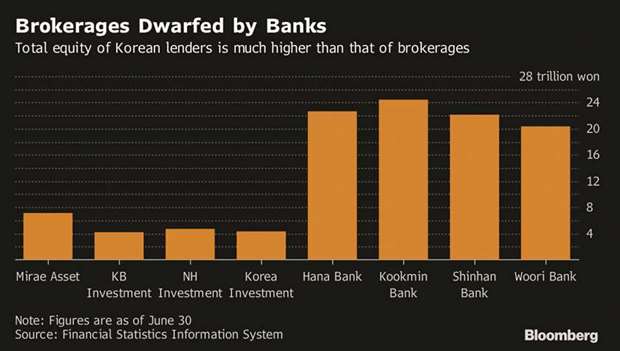
The road ahead will likely be a long one. Mirae Asset Daewoo Co, South Korea’s biggest brokerage, had a market capitalisation of 7tn won ($6.4bn). That compares with Goldman Sachs Group Inc’s $100bn.
The brokerages are also dwarfed by the nation’s banks, which operate branches across the country. The four biggest lenders including Kookmin Bank had combined total equity 89.6tn won at the end of June. The top four brokerages had 20.4tn won.
Korea Federation of Banks said last month it’s inappropriate for the government to approve brokerages’ issuance of promissory notes, and it should be put on hold. Authorities shouldn’t let the securities firms lend when they don’t have a banking license, the industry group said in a statement.
Korea Investment & Securities Co became the first Korean brokerage to issue promissory notes last month, selling 500bn won of the contracts, which are aimed at individual investors and can’t be traded on markets. The Seoul-based firm plans to offer 500bn won more by the end of the year.
Unlike stock and bonds, promissory notes have no minimum purchase amounts, making it easier to sell them to individuals. Better interest rates than bank deposits may also attract retail investors. Korea Investment sold one-year promissory notes at 2.3%. That compares with a 12-month time deposit rate of about 1.5% at big banks.
Brokerages need 4tn won or more in total equity to qualify for issuance. Mirae Asset Daewoo, NH Investment & Securities Co and KB Investment & Securities Co have also applied.
Mirae’s review has been put on hold, while the other two are being reviewed. The review for Samsung Securities Co was discontinued because Jay Y Lee, who is a major shareholder, is under criminal investigation, the FSC said last month.
Mirae Asset said on Friday that it will sell 700bn won of new preferred shares to boost its investment banking business. Its shares plunged 13.5% in Seoul yesterday, after dropping 4.6% on Friday.
Approved brokerages will be able to raise the equivalent of twice their equity at most.
Left behind: While the government tries to help bigger investment banks, it also wants them to help smaller firms left behind by the nation’s economic expansion. Some analysts question whether that will happen though.
“Nurturing big-sized investment banks is desirable for Korea’s economy and financial industry,” said Kang Kyeong-Hoon, a professor at Dongguk University’s business school in Seoul. “That said, just fattening them up doesn’t necessarily mean they’re going to play a role as investment banks.”
South Korea’s economy is set to expand more than 3% in 2017, the most since 2014, but much of that owes to the semiconductor industry which has created few jobs.
“We need more new startups that can grow like the US’s Google, Facebook and Amazon, which will help create employment, increase production and support economic growth,” said Korea Capital Market Institute’s Hwang.
“We need to support financing for growing companies, and the big investment banks should actively play the role.”
.