


Dr Zhaoyang Liu, senior scientist at Hamad Bin Khalifa University’s (HBKU) Qatar Environment and Energy Research Institute (Qeeri), has been selected for the editorial board of Scientific Reports’ – part of ‘Nature, the prestigious international journal.
This achievement “further bolsters” HBKU’s reputation as a “committed backer” of developing and enriching innovative research in the sciences, HBKU has said in a statement.
Scientific Reports is a publication geared towards a global audience of researchers and professionals with diverse backgrounds. It includes the latest research conducted across a multitude of fields, including the environment, energy, medicine, physics, chemistry and others.
Dr Liu joins reputable academics and scholars from a myriad of scientific disciplines, around the world, publishing high-calibre primary research on the natural and clinical sciences.
Commenting on his recent accolade, Dr Liu noted: “As members of a prestigious publication’s editorial board, we are entrusted with the responsibility to ensure that research papers being published are entirely accurate, factual and of the highest quality. I am extremely proud to represent HBKU on the international stage as a steward of knowledge in my role with ‘Scientific Reports’.”
Being selected for the editorial board is a direct result of Dr Liu’s research profile and high standing within the global scientific community, the statement notes. He has authored many renowned research papers in the fields of advanced materials, water treatment and energy storage.
For his work on water treatment, Dr Liu’s research has featured in top journals such as ‘Nature’. He is currently holding four international patents for technology developed in the area of water production, some of which have been successfully licensed to commercial enterprises.
Since joining Qeeri in 2014, Dr Liu, and his team have been conducting advanced research to find solutions to address Qatar’s water security grand challenge. He currently leads the pillar of water process development and optimisation, as part of the Water Security Research Portfolio. The pillar focuses on addressing the stakeholders’ pressing issues in seawater desalination and wastewater treatment.
For example, the oil/water separating technology developed by his team is being applied for treating oil/gas produced water, which is the biggest industrial waste stream in Qatar, with the aim of meeting quality standards of treated produced water and beneficial reuse for produced water.
Additionally, an innovative technology developed by his team is being used for the treatment and reuse of mosque ablution water for landscape irrigation, and a number of international patents have been filed to protect these technologies. Given his expertise and knowledge in membrane-based technologies, Dr Liu also is making his contribution by providing consultation on new government projects in seawater desalination with reverse osmosis membranes.
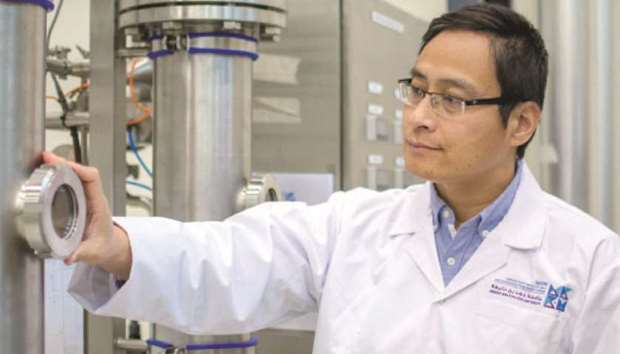
Dr Zhaoyang Liu