


Turkey’s central bank could raise its so-called late liquidity window without a monetary policy committee meeting “if inflation expectations worsen,” a senior adviser to President Recep Tayyip Erdogan said yesterday.
The regulator has “infinite” independence and would intervene on rates if needed, Cemil Ertem said yesterday in an interview on NTV television, amid calls from investors and analysts for tighter monetary policy to curb soaring prices. Hatice Karahan, another senior adviser to the president, said in Istanbul that the “central bank is watching what’s going in the markets.”
The central bank didn’t immediately respond to requests for comment yesterday.
The advisers’ remarks indicate the government is trying to reassure investors, two weeks after Erdogan said the central bank was on a “wrong path” in its fight against inflation, and reiterated his view that lower borrowing costs would better address price gains. Inflation reached 11.9% in October, far exceeding the central bank’s long-term target of 5%, and governor Murat Cetinkaya has warned of a two-month inflation blackspot through November.
The monetary policy committee is scheduled to meet next on December 14.
The central bank raised its year-end inflation estimate to 9.8% from 8.7% on November 1, driven by the depreciation in the lira and higher oil prices. Cetinkaya said at the time that price gains will only decelerate from December.
Karahan said yesterday that food and energy inflation were the main causes of the missed targets. “We have to deal with the pass-through effect as well,” she said, referring to the impact of a weaker currency on Turkish prices.
Ertem downplayed the potential market impact from the US trial of a former official at a Turkish state-run bank accused of conspiring to evade American sanctions on Iran. Turkish government bonds slid on Wednesday on fears the case could exacerbate tensions between Turkey and the US.
Bonds rebounded yesterday, with the yield on 10-year lira debt falling 23 basis points to 12.42% as of 3pm in Istanbul, down from a record 13.22% on November 22. The lira appreciated 0.5% against the dollar to 3.9418. Stocks also gained, with the benchmark Borsa Istanbul 100 index rising 0.6%.
“The government won’t allow the worsening of market conditions,” Ertem said, adding that any negative scenarios resulting from the trial were already priced in by traders.
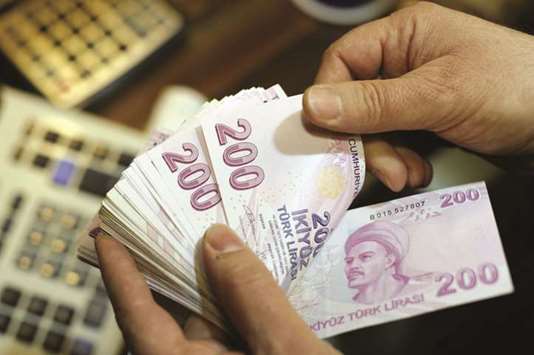
A money changer counts Turkish lira bills at a currency exchange office in Istanbul (file). The central bank raised its year-end inflation estimate to 9.8% from 8.7% on November 1, driven by the depreciation in the lira and higher oil prices.