


Pakistan’s government has called on the army to help clear a sit-in by Tehreek-i-Labaik Ya Rasool Allah Pakistan (TLYRAP) members blockading the capital after police clashed with activists and religious protests spread to other cities.
The interior ministry issued a notification under Article 245 of the constitution, which defines the functions of the armed forces, at the request of the capital territory administration.
The army would work to aid civilian institutions to restore law and order in Islamabad until further notice, the notification said, without explaining whether the army would take charge of the operation against the protesters or not.
Security sources said that troops from the 111th Brigade have moved to take part in an operation and they would be deployed as a third layer to back police efforts to break protests.
The number of troops is not known and can increase any time, the sources added.
More than 100 people were wounded in yesterday’s clashes, including at least 65 members of the security forces, according to reports from hospitals.
TLYRAP members said that four of their number had been killed, but police said there had been no deaths.
Television footage showed a police vehicle on fire, heavy curtains of smoke and fires burning in the streets as officers in heavy riot gear advanced.
Protesters, some wearing gas masks, fought back in scattered battles across empty highways and surrounding neighbourhoods.
By nightfall, protests spread to several other big cities with TLYRAP members brandishing sticks and attacking cars in some areas.
New demonstrators had joined the camp in Faizabad, just outside Islamabad, in a stand-off with police.
Private TV stations were ordered off the air, with only state-run television broadcasting.
Facebook, Twitter and YouTube were also blocked in many areas.
About 1,000 members from TLYRAP, a new hardline Islamist political party, have blockaded the main road into the capital for two weeks, accusing the law minister of blasphemy and demanding his dismissal and arrest.
“We are in our thousands. We will not leave. We will fight until end,” TLYRAP spokesman Ejaz Ashrafi told Reuters by telephone from the scene.
TLYRAP is one of two new religious political movements that have risen up in recent months and seem set to play a major role in elections that must be held by summer next year, though they are unlikely to win a majority.
Interior Minister Ahsan Iqbal told Reuters in a message last night that the government had “requisitioned” the military assistance “for law and order duty according to the constitution”.
The ruling party of former prime minister Nawaz Sharif – who was disqualified by the Supreme Court in July and is facing a corruption trial – has a fraught history with the military, which in 1999 launched a coup to oust Sharif from an earlier term.
Earlier in the day, Iqbal said the protests were part of a conspiracy to weaken the government, which is now run by Sharif’s allies under a new prime minister, Shahid Khaqan Abbasi.
“There are attempts to create a chaos in (the) country,” Iqbal said on state-run Pakistan TV.
“I have to say with regret that a political party that is giving its message to people based on a very sacred belief is being used in the conspiracy that is aimed at spreading anarchy in the country,” Iqbal added, without saying who he considered responsible.
Yesterday Pakistan’s army chief called on the civilian government to end the protest while “avoiding violence from both sides”.
Opposition leader Imran Khan called for early elections, saying that the “incompetent and dithering” administration had allowed a breakdown of governance.
The clashes began yesterday when police launched an operation involving some 4,000 officers to disperse around 1,000 TLYRAP members and break up their camp, police official Saood Tirmizi told Reuters.
The protesters have paralysed daily life in the capital, and have defied court orders to disband.
It was not clear how many protesters remained in the streets of the capital late yesterday.
There had been roughly 1,000 as the police operation began, but AFP reporters said dozens more were arriving throughout the day.
Many were galvanised by posts on social media, despite apparent efforts to block websites.
TLYRAP blames the law minister, Zahid Hamid, for wording in an electoral law that changed a religious oath proclaiming Prophet Muhammad the last prophet of Islam to the words “I believe”, a change the party says amounts to blasphemy.
The government put the issue down to a clerical error and swiftly changed the language back.
TLYRAP was born out of a protest movement lionising Mumtaz Qadri, a bodyguard of the governor of Punjab province who gunned down his boss in 2011 over his call to reform strict blasphemy laws.
The party won a surprisingly strong 7.6% of the vote in a by-election in Peshawar last month.
The government had tried to negotiate an end to the sit-in, fearing violence during a crackdown similar to 2007, when clashes between authorities and supporters of a Islamabad mosque led to the deaths of more than 100 people.
Weeks of inaction from authorities sparked the wrath of Pakistan’s judiciary, with the Supreme Court issuing a blistering statement earlier in the week and the Islamabad High Court threatening to hold government officials in contempt over the official response.
Analysts said the government had allowed a minor issue to grow into a headline-grabbing and potentially dangerous situation.
Even before yesterday’s clashes the sit-in had cost the life of an eight-year-old child whose ambulance could not reach a hospital in time due to the blocked roads.
“Politically driven procrastination has its own costs and this is what the government is paying,” analyst Imtiaz Gul told AFP, adding that the situation was “explosive”.
Despite the police crackdown, the protesters were largely still in place by nightfall and TLYRAP leader Khadim Hussain Rizvi, a prominent cleric, remained at the site, party member Mohammad Shafiq Ameeni said.
By late afternoon, TLYRAP supporters were coming out on the streets in other Pakistani cities in support.
Police fired teargas in Karachi, Pakistan’s largest city, to try to disperse about 500 demonstrators near the airport.
At least 27 injured – including 22 people with gunshot wounds – were brought to hospital, according to doctors.
Markets and shops were shuttered in the megacity, Pakistan’s commercial hub, as alarmed residents stayed inside while hardline clerics urged more people to take to the streets.
Outside the northwestern city of Peshawar, about 300 protesters blocked the motorway to Islamabad and started attacking vehicles with stones and sticks.
In the eastern city of Lahore, party supporters blocked three roads into the city.
An AFP journalist said a main artery road in Lahore was closed by police due to protests, while paramilitary rangers were set to be deployed.
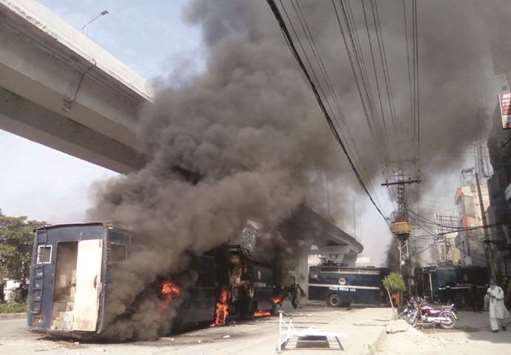
Rawalpindi residents walk past a burning prison van torched by TLYRAP members during clashes with police.