AFP/New York
The remnants of Irene reached Canada yesterday after barrelling through the northeastern US where the storm claimed at least 33 lives and caused estimated economic damage of up to $7bn.

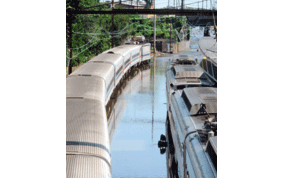
Trains remain idle at the Trenton Transit Center due to water on the tracks from Hurricane Irene yesterday in New Jersey. Rail service is shut down from Trenton to Boston along the Northeast
Millions of people were without power along the East Coast after the huge storm - now downgraded to a post-tropical cyclone - passed over the Big Apple and headed for Canada.
The Miami-based National Hurricane Center warned late Sunday of “major river flooding occurring in parts of the northeast,” after President Barack Obama cautioned that recovery efforts would last for “weeks or longer.”
“I want people to understand that this is not over,” Obama said in a short statement in the White House Rose Garden.
“I do want to underscore that the impacts of this storm will be felt for some time... Power may be out for days in some areas.”
The governor of Vermont, Peter Shumlin, said his state was in “tough shape” while New York state’s Andrew Cuomo warned of “tremendous flooding” in the Catskill Mountain area north of Manhattan.
In New Jersey, Governor Chris Christie said roads and rails were “impassable” in some areas, and much of the state had seen “significant flooding.”
Localised flooding occurred in the south and east of Manhattan, with more serious incidents in Brooklyn, where the famed Coney Island amusement park took a battering and outlying beaches were swamped.
There was heavy flooding along the low-lying south shore of Long Island where high tides, rain and ocean surge drove waves right up against expensive beach houses. Floods were also reported far inland after torrential rain.
At least 33 deaths were blamed on the storm, which first slammed into North Carolina on Saturday as a Category One hurricane, before turning north up the coast and weakening.
The youngest victim, an 11-year-old boy, died when a tree crashed through his apartment building in Newport News, Virginia.
Jose Miranda, director of Eqecat Inc, a catastrophic risk management firm from Oakland, California, told The Los Angeles Times that the storm could cost insurers from $1.5bn to $3bn to cover claims for damaged homes, vehicles and businesses.
Total damage, including uninsured losses, could range from $5bn to $7bn, he said.
By comparison, Hurricane Katrina which flooded much of New Orleans in 2005, reportedly cost more than $70bn in insured losses alone, the paper noted.
“I think the damage is much less severe than had been feared and the economic impact will, therefore, be a lot smaller than people predicted,” The Times quoted Mark Zandi, chief economist at research firm Moody’s Analytics, as saying.
New York area airports - John F. Kennedy International Airport, LaGuardia and Newark - were to reopen yesterday. More than 10,000 flights were cancelled across the eastern US.
The New York Stock Exchange was also set to reopen as normal yesterday morning.
“The good news is the worst is over and we will soon return to restore and return mode,” New York Mayor Michael Bloomberg said, announcing that 370,000 people ordered to evacuate could now go back home.
More than a million evacuees in New Jersey were also headed home, Christie said.
City officials however warned that commuting into New York could be a nightmare this week with no firm indication of when public transport would be back on track following an unprecedented shut-down just ahead of the hurricane.
“You’re going to have a tough commute in the morning,” mass transit chairman Jay Walder said.
Walder said buses could start running soon, but subway trains needed extensive testing of lines and equipment.
Irene also left swaths of territory without power, including 1mn in New York state, most of them on Long Island, according to Cuomo.
In New Jersey, 650,000 people had lost power supplies, while in the greater Washington area, nearly 2mn people lost electricity. In Massachusetts, 500,000 customers were without power.
Virginia’s Governor Bob McDonnell told MSNBC his state had seen the second biggest power outage in its history.
“It’s going to be days, perhaps a week, before all the power’s restored. We just ask people to be patient,” he said.
About 200,000 households have lost power in Canada, officials said.
Some 65mn people live in the urban corridor from Washington north to Boston. More than 4.5mn customers lost power in that area and well inland.
Hurricanes are rare in the northeastern US - the last major hurricane to hit New York was Gloria in 1985.
Meanwhile, the National Hurricane Center reported that a new tropical storm, Jose, had formed and was approaching Bermuda.
Deluge of births
As Hurricane Irene lashed the US East Coast, it brought a deluge of another sort to a North Carolina hospital - an unusually high number of newborn babies.
Seventeen babies were born at the New Hanover Regional Medical Center during an 18-hour stretch on Friday and Saturday when the hospital was on lockdown during the storm, spokeswoman Carolyn Fisher said.
“Certainly, it is noteworthy,” Fisher said of the seemingly inexplicable high number of births. “The normal average per day is more like 10 or 11.”
None of the mothers chose to name their infants Irene.
Fisher could not explain why the hospital saw so many births during the storm but added the birth rate petered out as Irene, now sweeping along the northeast coast as a tropical storm, passed and the lockdown on the hospital was lifted.
“It’s very quiet here today,” she said on Sunday, which she described as a “perfectly beautiful” day.