


AFP/Miami
Hurricane Irene ripped off roofs, downed power lines and demolished homes in the Bahamas and killed at least two people in Haiti as the US East Coast braced yesterday for its brute force. Packing winds of up to 185kph, Irene brought destruction to the Caribbean and Bahamas as it roared toward the US whose mainland has not been hit by a hurricane in three years.

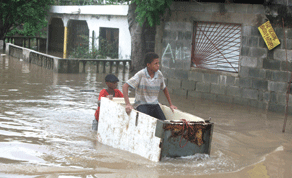
A boy pushes an old refrigerator, now used as boat for another child, in the middle of a street after it was flooded by the Nigua river due to the rains of hurricane Irene in San Cristobal, Dominican Republic
On the Bahamas’ remote Acklins Island, 90% of homes on the Lovely Bay settlement were destroyed after Irene’s eye passed through Wednesday, officials said yesterday. Water levels were said to rise by as much as 3.4m. Roads were flooded, power was cut off and utility poles were knocked down in parts of the tourism-dependent archipelago, but no casualties were initially reported after authorities put the country on guard.
Haiti, while not directly under Irene’s eye, suffered from heavy rains dumped by the hurricane. Civil defence authorities said that two people died when they were swept away by raging waters in a ravine.
Another 1,000 people were displaced by flooding caused by Irene, officials said, leading to fears of a new outbreak of cholera. The water-borne disease killed some 5,000 people in Haiti in the wake of last year’s major earthquake.
The deaths in Haiti bring Irene’s death toll to at least three after one person was killed in Puerto Rico, where the storm became a hurricane on Monday. Puerto Rican authorities estimated damage at more than $500bn.
While hurricanes are common in the islands, the US’ last major hit was in 2008 by Ike. Irene is expected to reach the New York area, which usually only experience hurricanes after they taper off.
The hurricane is expected to slam tomorrow into North Carolina, where Governor Bev Perdue declared a state of emergency and several counties on the Atlantic Coast ordered mandatory evacuations.
“There’s hardly any excuse for people not to know that there’s a hurricane out there,” Craig Fugate, head of the Federal Emergency Management Agency, told reporters on a conference call.
“People need to understand that their time will be running out to be prepared and be ready,” he said.
The agency said it had prepared three centres for emergency supplies including bottled water, food and medical supplies in case people need to spend extended periods of time in shelters.
In North Carolina’s coastal Dare County, where up to 180,000 people are believed to be present including summer vacationers, authorities warned that emergency personnel would not be able to reach anyone who defied the mandatory evacuation by Friday morning.
“If you choose to stay, we can’t issue a criminal citation, but you are leaving yourself wide open to extreme conditions,” county official Kelly Davis said.
But elsewhere in North Carolina at Wrightsville Beach’s Sweetwater Surf Shop, Alex Winslow said he was out on the waves along with more than 40 other adventurous surfers yesterday morning.
“The surf is still really clean and really fun,” said Winslow, a student at the University of North Carolina at Wilmington.
US military officers said that up to 98,000 members of the National Guard were available if needed. The Navy’s Second Fleet ordered all its ships away from its major port at Hampton Roads, Virginia, in anticipation of the storm.
In New York, Mayor Michael Bloomberg warned residents to prepare to move to higher ground as Irene heads toward America’s biggest city.
“If you have a car and live in a low lying area, park it on a hill,” Bloomberg told a press conference. “Move stuff upstairs.”
Bloomberg said that residents should not worry about skyscrapers - which were rattled in a rare earthquake on Tuesday but are built to withstand heavy winds. Instead, Bloomberg said damage may occur in old, low-rise buildings.