


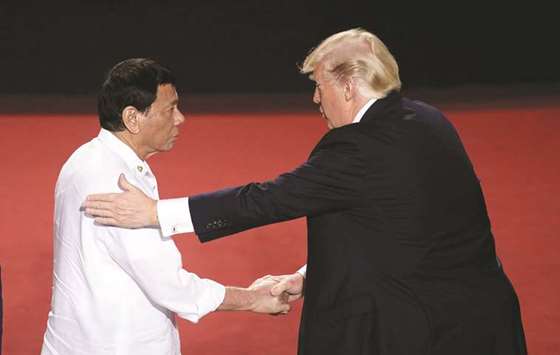
A spokesman for Duterte said there was no mention at all of human rights or extra-judicial killings during their conversation.
The meeting between the two presidents was one of the most anticipated at the summit of East and Southeast Asian leaders in Manila, with human rights groups pressing Trump to take a tough line on Duterte over his bloody war on drugs, in which thousands of people have been killed. “The conversation focused on ISIS (Islamic State), illegal drugs, and trade,” said White House spokeswoman Sarah Sanders. “Human rights briefly came up in the context of the Philippines’ fight against illegal drugs.”
Duterte’s spokesman, Harry Roque, told a news conference the Philippine president had explained his anti-drug policy at length to Trump, who “seemed to be appreciative of his efforts.”
“There was no mention of human rights, no mention of extralegal killings,” he said.
A joint statement released later by the White House listed human rights as the third of 14 topics discussed.
“The two sides underscored that human rights and the dignity of human life are essential, and agreed to continue mainstreaming the human rights agenda in their national programs to promote the welfare of all sectors, including the most vulnerable groups,” the statement said.
They discussed the Philippine campaign against crime, including illegal drugs, it said, and “committed to share best practices in the areas of prevention; enforcement, including capacity-building and transparency in investigations; and rehabilitation.” More than 3,900 people have been killed in a war on drugs that Duterte declared when he took office last year. His government says the police act in self-defence, but critics say executions are taking place with no accountability. “We are your ally. We are an important ally,” Duterte told Trump at the beginning of their talks, according to reporters allowed in to the meeting room.
Trump replied: “We’ve had a great relationship. This has been very successful. And the Association of Southeast Asian Nations (Asean) conference has been handled beautifully by the president in the Philippines.”
Duterte, who has been called the “Trump of the East” for his brash style and provocative language, said last week he would tell the US president to “lay off” if he were to raise accusations of rights violations.
Trump was criticised in May for praising Duterte during a phone call for the “great job” he was doing to counter illegal narcotics.The United States and the Philippines, a former US colony, have been strategic allies since World War Two.
But their relations have been strained by anti-US outbursts from Duterte and his enthusiasm for better ties with Russia and China.
However, Duterte clearly appears to be getting on better with Trump than he did with the American president’s predecessor, Barack Obama.
Trump and Duterte seem to have warmed to each other after meeting for the first time on Saturday at an Asia-Pacific Economic Co-operation (Apec) group meeting in Vietnam.
On Sunday, Duterte crooned hit Filipino love song “Ikaw” (You) at a gala dinner for summit leaders in Manila, saying it was on “the orders” of Trump.
One of the song’s verses, translated from Filipino, begins: “You are the light in my world, a half of this heart of mine”.
“Ladies and gentlemen, I sang uninvited, upon the orders of the commander in chief of the United States,” Duterte said later, according to the ABS-CBN news channel.
Roque described the relationship between Trump and Duterte as “warm, friendly and candid.”
“It’s very apparent that both of them have a person who they consider as not a best friend,” he added. “They have similar feelings towards former US president Barack Obama.”
Water cannon repel protesters against US president
Riot police used water cannon and sonic alarms to repel hundreds of protesters shouting anti-Donald Trump slogans on the sidelines of a major summit in Manila yesterday. Colourful effigies of the US president, including one with four arms in the shape of a Nazi swastika, were carried through the streets of the Philippine capital.
A likeness of Philippine President Rodrigo Duterte peeked out from behind the figure, as the two leaders readied to sit down for formal talks less than three kilometres (two miles) away.
Protesters carried placards that read “Trump Go Home” and “Ban Trump #1 terrorist”.
Police said there were nearly 2,000 people at the rallies. They were met with riot police — some wearing flak jackets and carrying rifles — who fired water cannon and sounded high-pitched alarms.
At least six police officers were injured in the melee, an AFP reporter at the scene said.
“They hit us with wooden sticks. One of my colleagues was hit in the face by a rock,” police officer Ramon Dumagat said, his arms covered in reddish welts. Rights groups have called on Trump to speak out over Duterte’s drugs war, which has seen police and suspected vigilantes kill thousands of people during his 16 months in power.
But the one-time property magnate, who is on the final stop of a tour of Asia, has so far shown nothing but warmth for a strongman leader who has boasted of personally killing people.
Satur Ocampo, a former communist rebel leader and ex-congressman who was among the demonstrators, said he had little hope Trump would raise a drug war that critics say could amount to a crime against humanity. “They think alike,” he said.
“He let Trump sit beside him at (Sunday evening’s) banquet, gave him a place of honour.”
The Association of Southeast Asian Nations is hosting two separate events and it will end today in Manila. They also include China, Japan, Russia, South Korea, India, Canada, Australia and New Zealand, as well as the United States.
The rising threat of the Islamic State group across Southeast Asia, and efforts to pressure North Korean leader Kim Jong-un to abandon his nuclear ambitions, are top agenda items.