


 |
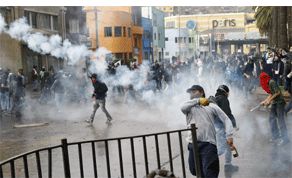
| Chilean students take part in a protest against the government to demand changes in the public state education system in Valparaiso city, about 121km northwest of Santiago, on Tuesday |
Tens of thousands of teachers, students, parents and sympathetic labour activists marched in downtown Santiago for the fifth time in two months to demand reforms from the conservative government of President Sebastian Pinera.
The peaceful protest came apart when a group of hooded youths hurled sticks and rocks at riot police near the presidential palace of La Moneda. Some of the youths smashed street lights and broke windows, and a car was set ablaze.
In updated figures, police said some 70,000 people marched, while organisers put the number closer to 150,000.
Either way, the recent wave of student protests is the largest since democracy was restored in Chile in 1990 after 17 years of military dictatorship.
“The government is not listening to us, we want a new education system in Chile and the government proposals do not address what we want,” said Manuel Soto, a protester from the University of Santiago.
“The protests will continue... until the government gives us better education,” he said.
Protests also took place in Chile’s other main cities, including Arica, Valparaiso and Concepcion, and hundreds marched in solidarity in Argentina, where there is a large population of Chilean college students.
Deputy Interior Minister Rodrigo Ubilla confirmed 273 marchers were arrested across Chile, including 72 in Santiago. Ubilla also said that 23 police were wounded in Santiago rioting.
Students want the state to take over the public school system, where 90% of the country’s 3.5mn students are educated.
The nationwide school system was broken up during the 1973-1990 military regime and handed over to local authorities. Protesters say the current system results in deep inequalities and is underfunded.
Students also want more affordable higher education: most Chilean college students take out loans to go to private for-profit universities because public colleges are few and short of funding.
“I’m marching because I have two children and I can’t make ends meet; they are going to be in debt for years” when they go to college, Graciela Hernandez, one of the protesters, said.
Chile has the highest per capita income of any country in Latin America, but the Andean nation also has one of the most skewed income disparities in the region.
Student leader Camila Vallejo hailed the protest as a “success” and called on Pinera’s government to allow the Chilean people to directly decide the future of education in a referendum.
The government, however, appeared inflexible on the issue with Interior Minister Rodrigo Hinzpeter urging “the whole country” to “reflect” on the damage caused by the protests.