


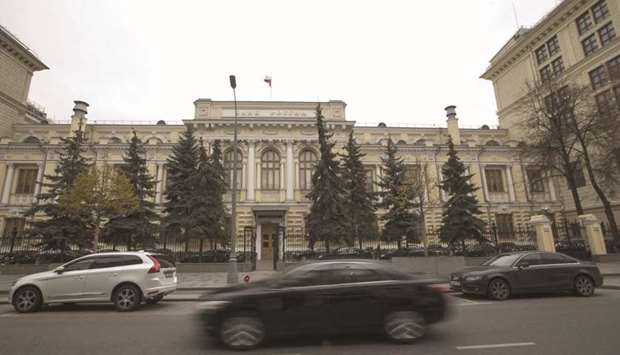
The Bank of Russia has twice used a new rescue fund since the end of August to take over lenders so it doesn’t spend money outsourcing such bailouts to the private sector. The nationalisations of B&N Bank PJSC and Bank Otkritie FC came with a range of businesses that complicate efforts to ultimately sell the banks back into private hands.
In B&N’s case, shareholders gave assets including chicken plants, cement factories and lumber yards to the Bank of Russia to help plug the hole in its capital uncovered when the regulator took over in September, according to Deputy Governor Vasily Pozdyshev.
“I’d like to see the chicken that can lay an egg big enough to fill the hole in B&N’s balance sheet,” said Tom Adshead, chief operating officer of the Moscow-based consultancy Macro Advisory. “I suspect the central bank will try to sell the assets quickly so their value doesn’t deteriorate without a proper owner.”
The unusual – and difficult to value – assets highlight a dilemma the regulator faces as it takes a more hands-on approach to rescuing troubled institutions. Previously, it had attempted to rescue lenders by providing investors with cheap credit in a strategy that often failed to restore them to health.
While the central bank estimates the rescues of B&N and Otkritie, which will both be cleaned up using its newly minted consolidation fund, could cost as much as 820bn roubles ($14bn), a more precise estimate will depend on a better understanding of the lenders’ books. This task is made more difficult by the sheer number of related-party loans issued, often for illiquid collateral that is hard to value.
B&N’s related-party lending is a bigger issue than its books show because the lender met formal criteria for credit-risk concentration even while the loans were financing its owners’ businesses, Interfax reported, citing central bank first deputy governor Dmitry Tulin in Novosibirsk on Thursday.
In B&N’s case, the bank’s main shareholders, billionaire Mikhail Gutseriev and his nephew Mikail Shishkhanov, agreed to give the regulator assets that Vedomosti newspaper estimates are worth at least 70bn roubles to partially compensate for the hole in their banking group’s capital.
These assets come from the family’s holdings and some of them were pledged other banks that will need to sign off on the transfers, according to Pozdyshev. Some of the assets, such as shares in oil company Russneft PJSC, are publicly traded and easily valued. However, putting a price tag on others – including a giant vegetable warehouse outside of Moscow and nanotechnology firms – is more difficult.
The central bank and Shishkhanov didn’t respond to requests for comment about the assets that were given to the regulator. Pozdyshev said last week it was up to the bank’s temporary administration to estimate their value.
B&N and Otkritie grew rapidly in the aftermath of US and European Union sanctions that hit many state-owned banks and limited their operations. B&N assets jumped fivefold since 2014, during which time Otkritie grew into Russia’s largest private lender, as it expanded through acquisitions and received state money to rescue smaller competitors.
The central bank turned a blind eye to the expansions as it dealt with a series of crises, from the rouble’s collapse in late 2014 to a campaign to shut down smaller lenders with insufficient capital or poor management, an effort that’s reduced the number of Russian bank licenses by one-third over the last three years.
“I don’t think the central bank has a strategy yet for those assets, as they just focus on the immediate goal of recovering as much as possible,” said Alexander Danilov, a Fitch Ratings analyst. “They will decide what to do with them later.”
That task will fall to Mikhail Zadornov, a former finance minister and currently the head of VTB Group’s retail division, who’s been picked to lead Otkritie starting in January. The central bank plans to merge Otkritie and B&N before they are marketed to investors.
The growing Russian economy may help salvage the value of some of these assets, according to Zadornov.
“The clean-up wasn’t brought on only by managers’ misguided policies, but also by the impairment of assets that were acquired with the expectation of future economic growth,” Zadornov said in an interview in October. “The growth wasn’t there and the assets lost value. If there’s growth, there will be another view of the various assets.”