


Thousands of people across Britain marked Armistice Day, the end of World War I in 1918, with a two-minute silence yesterday to remember the country’s war dead.
Military leaders and politicians, wearing red poppies to symbolise the loss of life, joined veterans and other members of the public at the Cenotaph war memorial in central London, close to Britain’s parliament and main government offices.
The two-minute silence began at 11am (1100 GMT) after 11 chimes from the Big Ben bell in the nearby clocktower of parliament.
Similar ceremonies took place at nearby Westminster Abbey and in Plymouth, Brighton and other cities across Britain.
The BBC paused its news broadcasts for two minutes, while some shops and cafes also observed the silence.
In Paris, French President Emmanuel Macron marked the 99th anniversary of the end of World War I by laying a wreath at the Arc de Triomphe, where an eternal flame burns at the grave for the unknown soldiers.
Former president Francois Hollande and Nicolas Sarkozy also attended the Armistice Day ceremony in Paris.
Armistice Day marks the anniversary of an armistice signed by France, Germany and Britain on November 11, 1918, ending World War I.
Remembrance Day, which is marked in Britain by the sovereign at a larger ceremony in London, is held the Sunday after Armistice Day.
This year, Queen Elizabeth II, 91, will watch the Remembrance Day ceremony from a balcony for the first time, allowing her son, Prince Charles, to lay a wreath at the Cenotaph today on her behalf.
The queen and other members of the royal family, plus politicians including Prime Minister Theresa May, were scheduled to attend a remembrance festival in the evening yesterday at London’s Royal Albert Hall.
The Cenotaph, which means “empty tomb”, is a monument to more than 1mn British military personnel who died in modern wars, including nearly 900,000 who died in World War I.
In northern France on Friday, representatives of Britain, France, Belgium, Canada, Australia and New Zealand marked the 100th anniversary of the Battle of Passchendaele, which left some 500,000 Allied and German soldiers dead or injured.
Also on Friday, Macron and German President Frank-Walter Steinmeier reaffirmed the friendship between the former European rivals as they opened a joint war museum at one of WWI’s bloodiest battlefields (see also page 18).
About 30,000 soldiers from both countries died fighting over the Hartmannswillerkopf mountain in Alsace, nicknamed the “eater of men”.
“The mass killings on this site stand for the insanity of war,” Steinmeier said after a tour of the battlefield and the new museum.
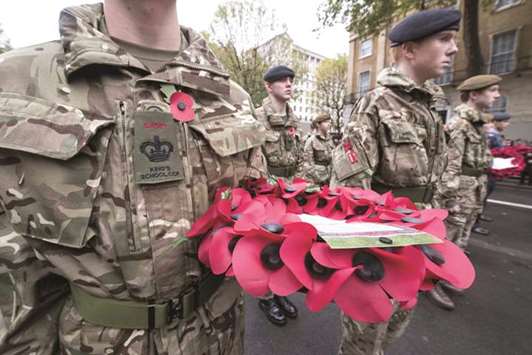
Army cadets prepare to lay a wreath during the Western Front Association’s (WFA) annual service of remembrance on Armistice Day, at the Cenotaph in central London.