


 |
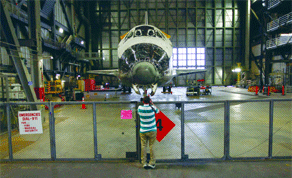
| Decommissioned space shuttle Discovery is temporarily stored in Nasa’s Vehicle Assembly Buidling in Cape Canaveral, as technicians continue to ready it for transport to Washington, DC’s National Air and Space museum. With the return of space shuttle Atlantis scheduled for today, the shuttle programme comes to an end after 30 years of flight |
Shuttle Atlantis and its four-member crew are due back at the Kennedy Space Center in Florida at 5:57am EDT (0957 GMT) today after a mission to resupply the International Space Station, a $100bn project of 16 nations, currently orbiting about 250 miles (400km) above the planet.
Nasa points to the station, finished this year after 12 years of assembly by shuttle crews, as the programme’s crowning achievement, but it is far from the only one.
“Space shuttle has provided unbelievable benefit and return on the investment of the American taxpayer,” said Nasa deputy administrator Lori Garver.
That investment, including development and operational costs over the past 40 years, tallies about $200bn, according to a recent University of Colorado study.
The shuttle programme also took a toll in human life, with 14 astronauts killed in two separate accidents.
In addition to carrying 180 satellites into orbit - myriad probes from the grandiose Hubble Space Telescope to the tiny PicoSat solar cell test-bed released by the Atlantis astronauts yesterday - the shuttle programme spawned more than 100 spinoff technologies for medical, industrial and other terrestrial uses.
Technology used in space shuttle fuel pumps, for example, led to the development of a miniature heart pump weighing less than 4 ounces (113 grams). Shuttle wiring problems discovered in 1999 triggered a new self-healing insulation repair technology, which is being commercialised with Federal Aviation Administration funding.
Ford Motor Co used a system originally developed to detect shuttle hydrogen gas leaks to produce a car-powered by natural gas.
Just building the shuttles in the 1970s revolutionised aircraft, which previously used manual, rather than “fly by wire” electronic flight control systems that are prevalent today. Similar technology has since been widely adopted by the automotive industry for “drive by wire” systems.
Nasa hopes the real payoffs of the shuttle programme will come from an expanded research programme aboard the International Space Station, which is staffed by six astronauts and cosmonauts from the US, Russia, Europe, Japan and Canada, a partnership that began with shuttle missions.
“We’ve assembled it and now it’s our job to utilise it,” said Nasa station programme manager Mike Suffredini.
“It’s going to result in research that’s going to benefit humanity and our planet. The things we’re going to learn from ISS we just don’t even know today and in some cases can’t even fathom yet,” the US space agency veteran said.
“It could have only been built with shuttle,” he added.
Nasa devoted 37 of its 135 shuttle missions to building and servicing the station. Now that it is complete, the shuttles are being retired to free up funds to develop new spaceships that can travel to the moon, asteroids, Mars and other destinations where shuttles cannot go.
“The shuttle programme to me was an evolutionary step off the planet and into the heavens. We have learned to live and work in low-Earth orbit,” launch director Mike Leinbach said before Atlantis’ July 8 liftoff.
“I think we as a species need to be thinking about living off this planet, long-term. That ought to be the mission.”
Nasa is counting on commercial providers to develop space taxis to fly astronauts to and from the space station, providing a backup to the Russian Soyuz spaceships that will cost the US more than $50mn per seat to use. China, the only other country that has flown people in space, is not a part of the space station partnership.
The government’s retreat from the space transportation business opens opportunities for new industries, such as space tourism and private flights for research and education.
“I think the shuttle will always be seen as a workhorse, but an expensive one,” said commercial space advocate Peter Diamandis, founder of the $10mn Ansari X Prize competition for the first private manned suborbital space flight.
“The shuttle gave the appearance of regular, easy access to space, but it was anything but that. It took the blood, sweat and tears of a talented army to keep it flying. Hopefully many lessons can be learned on how to create a safer and lower-cost system in the future,” he said.