


Name
the country. Its leader rails against foreigners, erects various import
barriers, and pushes for low interest rates and lots of cheap credit
for favoured sectors. Government debt is already high, but the would-be
strongman in power decides to pile on even more by increasing the budget
deficit, arguing that this will boost prosperity to previously
unattainable levels. While the government claims to represent the common
people, state contracts are awarded to friends of friends.
The
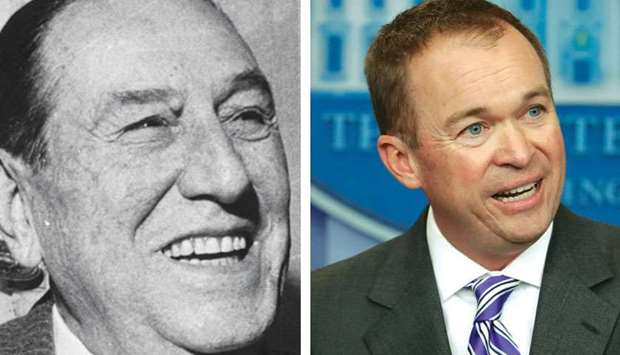
answer, of course, is Argentina under Juan Per?n, who was in power from
1946 to 1955 (and again briefly in 1973 and 1974), and many of his
successors. One of the richest countries in the world around 1900 was
laid low by decades of unsustainable economic policies that made people
feel good in the short run but eventually ended in disaster, such as
runaway inflation, financial crisis, and periodic debt defaults. (To be
clear, Argentina’s economic policies today are quite different; for deep
and up-to-date analysis, I recommend the work of my colleague Alberto
Cavallo.)
But if your answer was the United States under President
Donald Trump, you would not be far off. There is reason to fear that the
US is now on the path to what was previously known as Latin American
populism.
Consider the remarkable volte-face of the Republican Party
on fiscal responsibility. There used to be a national debt clock in the
hearing room of the House Financial Services Committee, and Republicans
would rant about government profligacy as it ticked upward. When I was
in that room recently, the clock was “under repair.”
Self-proclaimed
“fiscal conservatives,” such as Mick Mulvaney (a former member of the
House of Representatives who now runs government finances as head of the
Office of Management and Budget), are close to enacting a massive tax
cut, despite knowing that it will drive up the deficit and the national
debt. Mulvaney and his colleagues could not care less.
Despite
controlling both Houses of Congress and the presidency, the Republicans
are beset by internal divisions. As a result, they are finding it hard
to “pay for” the tax cuts with any reduction in tax expenditures
(incentives for various activities such as corporate borrowing, mortgage
financing, or retirement saving). But Republicans are deeply committed
to gigantic tax cuts, in large part because their donors are demanding
that they enact them. As a result, the US will merely end up with bigger
budget deficits.
Facts used to matter in Washington, at least a
little bit. But this is no longer the case in the age of Trump, at least
not when it comes to taxes. Instead, the strategy has been to state, in
a bald-faced manner whatever one wants to believe and heap ill-mannered
abuse on anyone who cites evidence to the contrary.
In Chapter 3 of
White House Burning, James Kwak and I reviewed what happened after the
tax cuts enacted in 2001 under George W Bush. Great promises were made
about the cuts, including that they would help most Americans. But while
they did help rich people become richer, there is no evidence that they
delivered faster growth or higher incomes for the middle class.
Instead, they boosted the budget deficit and contributed significantly
to increasing the US national debt (by around $3tn through 2010), which
weakened the government’s ability to respond to crises, either in terms
of national security or financial instability.
I have testified
repeatedly before Congress on matters of fiscal policy. During the
financial crisis of 2008-2009, Republicans were certainly interested in
the facts. But this quickly tapered off, most notably in the House of
Representatives. In fact, Kevin Brady, the representative who told me
most clearly that he was not interested in looking at even moderately
inconvenient facts, is now Chair of the House Ways and Means Committee,
which plays a key role in what happens with taxes.
Ron Wyden, the
senior Democrat on the Senate Finance Committee, calls the proposed
Republican tax cuts “a middle-class con job.” He is being polite.
The
cut in corporate taxes that the Republicans are likely to support will
not boost wages significantly. As the Congressional Research Service,
describing the broader blueprint put forward by House Speaker Paul Ryan,
has put it, “the plan’s estimated output effects appear to be limited
in size and possibly negative.”
Including all possible positive
effects of the Republican proposals, the Tax Policy Centre has concluded
that federal government “revenue would fall by between $2.4tn and
$2.5tn over the first 10 years and by about $3.4tn over the second
decade.”
The Trump administration has responded to this type of
sensible, fact-based analysis in the way one has come to expect: by
being rude.
American populism in the Trump era, though promising
great gains for working people, will in fact benefit only those who are
already rich. To be fair, this is quite a twist on anything Per?n could
have imagined pulling off. The results of irresponsible populism,
however, are always the same. – Project Syndicate
* Simon Johnson
is a professor at MIT’s Sloan School of Management and the co-author of
White House Burning: The Founding Fathers, Our National Debt, and Why
It Matters to You.
Juan Peron, who was in power in Argentina from 1946 to 1955 (and again briefly in 1973 and 1974). Right: Budget Director Mick Mulvaney speaks to reporters in this February 27 file picture.