


China’s central bank tried to calm a nervous bond market yesterday with more liquidity injections, helping to steady 10-year yields following a sell-off, as anxiety deepened about a renewed crackdown on riskier lending even as the economy showed signs of slowing.
Trepidation in the debt market had also hurt Chinese stocks, with the Shanghai Composite Index edging up only slightly in the session after its worst slide in 11 weeks the day before. “It seems that markets are anxious or are expecting regulators to tighten the screws further in the coming months,” said Louis Kuijs, head of Asia economics at Oxford Economics.
Top policymakers at China’s twice-a-decade Communist party congress last week said that efforts to contain excessive risk-taking in the financial system would continue next year, with hints of more regulations in areas such as interbank borrowing and wealth management products.
Following the congress, the implications of tighter curbs on debt risks have shaken bond investors, sending yields on Chinese 10-year treasury bonds surging to a three-year high of 3.917% at one point on Monday amid what traders characterised as panic selling.
However, the central bank’s net injection of funds for a fourth straight day had brought a semblance of stability to the market, with the 10-year yield flat at 3.89%.
Still, underlying worries about a liquidity crunch and the broader efforts to reduce debt were further amplified by a survey showing a sharper-than-expected slowdown in China’s factory growth in October.
That added to signs of a slowdown in China’s economy, and pressured stocks. China’s blue-chip CSI300 index finished the day flat, while the Shanghai Composite Index edged up by just 0.1% after spending most of the day in negative territory. The market spasms follow PBoC governor Zhou Xiaochuan’s recent warning of the risks of a “Minsky moment” in the economy, referring to a sudden collapse in asset prices after long periods of growth, sparked by debt or currency pressure. Faced with selling pressure, the central bank has moved to reassure the market with liquidity injections to offset 1tn yuan ($150.93bn) in reverse repos and medium-term lending facility (MLF) loans maturing this week, including a net 80bn yuan injection yesterday.
The PBoC has also asked banks about their demand for MLF loans, and may inject money via the facility on Friday, according to a source with knowledge of the matter. A trader at an asset-management firm in Shanghai said the moves had helped “a little bit” to calm market nerves.
“But money market rates are still high.” Institutions paid as much as 5.95% to borrow overnight money yesterday, reflecting strong cash demand at the end of the month.
Tuesday’s net 80bn yuan injection was “not enough” to significantly affect market sentiment, said the trader, adding the PBoC was probably unwilling to inject a greater amount due to the broader deleveraging push.
“The PBoC only offers first aid,” he said. Traders said that the bond sell-off was concentrated in government and policy-bank bonds because of their greater trading liquidity, but warned of the potential for selling to spread if rates continue to rise.
Bond yields for top-rated issuers gained half a basis point yesterday and are 3 basis points higher since Friday.
Yields on debt from lower-rated borrowers have risen about 10bps to 5.545% since Friday.
“It is hard to sell credit bonds but I expect them to re-price based on the moves in the government bonds,” said a Shanghai-based trader at a European bank. Some market watchers say the sell-off in the bond market may have been been overdone.
“Yields are rising due to a combination of factors — the deleveraging message from the national congress, GDP growth not disappointing and expectation that the PBoC will keep liquidity tight,” said Frances Cheung, Westpac Head of Macro Strategy, Asia.”
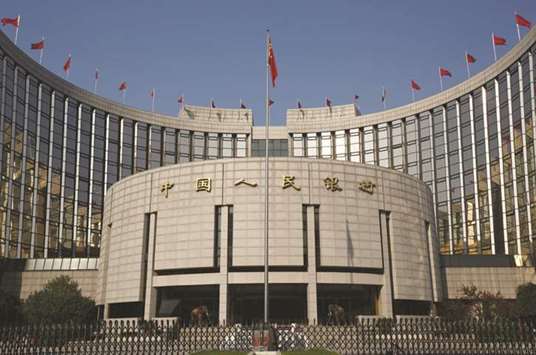
The People’s Bank of China headquarters in Beijing. The PBoC tried to calm a nervous bond market yesterday with more liquidity injections, helping to steady 10-year yields following a sell-off, as anxiety deepened about a renewed crackdown on riskier lending even as the economy showed signs of slowing.