


China’s
quinquennial Communist Party congresses are that rare event where
ritual and dogma combine with introspection and strategy. The 19th
National Congress, which began on October 18, is no exception.
Notwithstanding
the suspense over potential changes in party leadership, which
typically occur at the end of the meeting, President Xi Jinping’s
political report, delivered on the opening day, was a high-impact event.
Significantly, it says as much about the Party as it does about Xi. As
Alice Miller, a leading Sinologist at Stanford’s Hoover Institution,
emphasises, the report was carefully crafted over a one-year period to
convey the consensus of the Party’s highest organ, the 205-member
Central Committee.
Three conclusions from Xi’s address are
particularly important. For starters, the ideological underpinnings of
“Xi Jinping Thought” have been raised to the same lofty level as those
of “Mao Zedong Thought,” effectively elevating Xi over his three
predecessors – Hu Jintao, Jiang Zemin, and even the revered Deng
Xiaoping. Much has been written about Xi’s consolidation of power since
he was appointed General Secretary in November 2012. But this elevation
makes it official. After only five years in office, the Party leadership
has anointed Xi as one of modern China’s two greatest historic figures.
Second,
the political report speaks with great confidence about a China that
has now entered a “New Era.” But by underscoring the Chinese adage that
the “…last leg of a journey just marks the halfway point,” Xi sketched
an even more ambitious future.
China’s sights are now set on two
goals – completing the task of building the so-called moderately
prosperous society by 2035, and then establishing its position as a
Great Power by 2050. Unlike China’s goal-setting exercises in the past,
there are no quantitative targets attached to these “twin centenary
goals” (which roughly align with the Party’s founding in 1921 and the
establishment of the People’s Republic of China in 1949). They celebrate
the long-awaited national rejuvenation that Xi has dubbed the China
Dream.
The third point is perhaps the most intriguing. This is
couched in the form of China’s “principal contradiction” – a Marxist
concept that serves as an admission of a fundamental problem requiring
resolution. The principal contradiction, while typically elliptical and
ambiguous, frames a rich discussion of risks and opportunities, strategy
and tactics, reforms and governance – all of which will shape China’s
prospects for the foreseeable future.
The big news is that, under
Xi’s leadership, the party has revised its principal contradiction for
the first time since 1981. Whereas the contradiction had previously been
framed as a tradeoff between the needs of the people and China’s
“backward social production,” it is now viewed as a tension between
“unbalanced and inadequate development” and the “people’s ever-growing
needs for a better life.”
This restatement of the principal
contradiction has not emerged from thin air. It clearly signals a
far-reaching change in national perspective – from that of a poor
developing country to that of an increasingly prosperous society focused
on becoming a Great Power. It is also consistent with the critique of
former Premier Wen Jiabao, who in March 2007 famously warned of a
Chinese economy that was becoming increasingly “unstable, unbalanced,
unco-ordinated, and [ultimately] unsustainable.”
Over the past ten
years, two five-year plans – the 12th, enacted in 2011, and the 13th,
enacted in 2016 – plus a major set of reforms adopted at the so-called
Third Plenum in 2013, have aimed to resolve China’s persistent and
worrisome imbalances. Xi’s political report doesn’t alter the main
thrust of those efforts. The real significance is that rebalancing is
now enshrined within the Party’s ideological underpinnings. It is a
foundational pillar of Xi Jinping Thought.
The political report’s
focus on China’s principal contradiction also raises important questions
about what still may be missing from the Party’s long-term strategy.
Three “secondary contradictions” are especially striking on the economic
front.
First, there is ongoing tension between the role of the state
and that of markets in guiding resource allocation. This was a glaring
contradiction of the 2013 Third Plenum reforms, which focused on the
seemingly inconsistent combination of a “decisive role” for markets and
steadfast support for state ownership.
The party has long believed
that these two features of economic life are compatible – the so-called
blended economy with Chinese characteristics. Xi’s political report
praises the mixed ownership model and also aspires to an economy led by
great firms with unmatched global competitive prowess. But it glosses
over the thorny issue of state-owned enterprise reform that may be
required to resolve this contradiction and avoid the Japanese “zombie”
problem of a chronic debt overhang.
Second, there is the tension
between supply and demand. Consistent with other recent pronouncements
of senior Chinese officials, the political report leaves little doubt
that supply-side structural reforms are now the highest priority of
economic policymakers. The related emphasis on productivity, innovation,
pruning excess capacity, and moving up the value chain in manufacturing
and services are underscored as key building blocks of this effort.
At
the same time, the report de-emphasises consumer spending and services –
now buried deep in the list of priorities for a modernised economy. Yet
focusing on supply without paying equal attention to the foundations of
aggregate demand is a puzzling and potentially worrisome disconnect.
A
final secondary tension can be found in the contrast between the path
and the destination. Notwithstanding all the self-congratulatory
flourishes in Xi’s political report, there is good reason to believe
that the Chinese economy is only in the early stages of its
long-heralded structural transformation. Its services sector is growing
rapidly, but is still embryonic, accounting for just 52% of GDP. And
household consumption, which is also growing rapidly, is still less than
40% of GDP.
China may well be on a path to a New Normal or a New
Era. But the final destination remains far down the road, with many
contradictions to be resolved during the journey. – Project Syndicate
* Stephen S Roach, a faculty member at Yale University and former
Chairman of Morgan Stanley Asia, is the author of Unbalanced: The
Codependency of America and China.
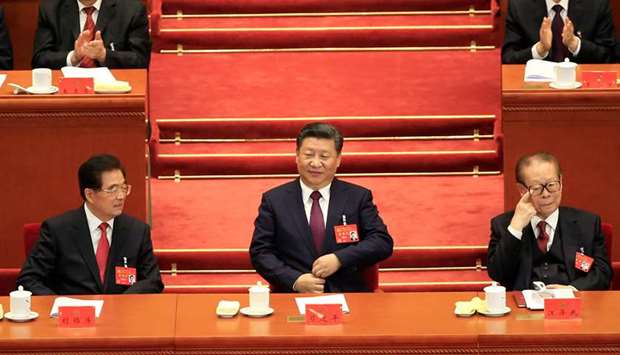
From left: Former Chinese president Hu Jintao, Chinese President Xi Jinping and former Chinese president Jiang Zemin are seen during the opening session of the 19th National Congress of the Communist Party of China at the Great Hall of the People in Beijing.