


FIFA leader Gianni Infantino insisted yesterday that football’s world body is no longer a “toxic” brand shunned because of scandals that embroiled past leaders. Infantino hailed the increase to $400mn in prize money for next year’s World Cup in Russia — including $38mn for the winning team — as a sign of FIFA’s success.
The $48mn increase from 2014 and toughened bid rules for the 2026 tournament were both agreed by FIFA’s ruling council at a meeting in Kolkata. The increase is “a positive sign in terms of the healthy financial situation of FIFA,” said Infantino who took over from the scandal-tainted Sepp Blatter in February last year. Infantino said bidding regulations for future World Cups have to be “bullet-proof” after the past scandal that saw FIFA lose sponsors. “The bidding regulations are of course a milestone in not only FIFA’s history but I think in the history of sports organisations in the way bidding processes are conducted,” said Infantino.
The changes will mean the rival offers by a joint US/Canada and Mexico bid and from Morocco will face greater scrutiny from an independent external auditor. The bids and the FIFA evaluation committee will also face new restrictions on their activities. “We want to make sure that the bidding process for 2026 is absolutely bullet proof,” he said. FIFA reported a $122mn loss for 2015 which it blamed on the legal costs from the scandals. It had to dig into its $1.5bn reserves to pay the cost. But it still set a target of $5.65bn in revenues for the four year cycle between the 2014 and 2018 World Cups. FIFA aims for a $100mn surplus between its revenues and spending, which is mainly on national associations and running tournament like the World Cup.
New club competition may replace Confederations Cup
Meanwhile, FIFA could replace the Confederations Cup with a new world club competition, Gianni Infantino said. The FIFA chief also confirmed that FIFA will officially recognise as world club champions the winners of the old Intercontinental Cup dating back to 1960 — a contest that became notorious for some of the most unsavoury matches in the sport.
FIFA currently organises a Club World Cup every year, featuring the champion clubs of each continent, but it has recently suffered from European dominance with teams from other regions unable to mount a serious challenge.
The Confederations Cup is held in the year before a World Cup and features the respective national team champions of each continent. Infantino stressed that it was important not to further congest the international calendar. “One option could be to organise it instead of the Confederations Cup,” he said. The Club World Cup has been held in its current form since 2005. Before that, from 1980 to 2004, a single match was played between the champions of Europe and South America in Tokyo.
FIFA fails to take decision in Israel-Palestinian dispute
FIFA’s leadership refused yesterday to intervene in a dispute between Israel and the Palestinians over football in the occupied territories, opening up a likely confrontation at the international sports tribunal.
The world body’s ruling council declined to adopt any of three possible actions recommended by an international commission which spent more than two years looking at the long-running battle. The FIFA Council said it “must remain neutral with regard to political matters” in line with the world body’s statutes.
The Palestinian football association had demanded FIFA sanctions over six teams playing in the Israeli league which are based in Israeli settlements in the occupied West Bank. Infantino called the dispute “exceptionally complex” because of the political situation in the Middle East. It involved “issues which are there since 10,000 years and have not been solved yet and football is not going to solve them either I am afraid,” he said
The Palestinians complain that their players face harassment and even arrest by Israel when trying to move between the occupied West Bank and Gaza and that some have been prevented from travelling to international tournaments.
The Palestinian Football Association (PFA) said Israel had breached FIFA statutes which state that a member country’s teams cannot play matches on the territory of another association without permission. Israel said FIFA should stay out as there are no recognised frontiers for a Palestinian state. The CAS could force FIFA to hold a vote at its next congress on the Palestinian demands. Infantino said that FIFA would follow any CAS decision.
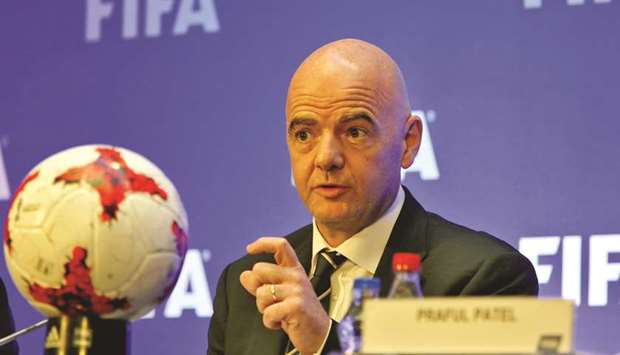
FIFA President Gianni Infantino speaks after a FIFA Council meeting in Kolkata, India, yesterday. (Reuters)