


Iraqi Prime Minister Haider al-Abadi ordered a 24-hour suspension to military operations against Kurdish forces in northern Iraq, to allow for the peaceful deployment of Iraqi troops at the border crossings with the Kurdistan region.
A Kurdish spokesman earlier said the two sides reached an agreement yesterday to stop fighting which broke out on Oct 16, after Iraqi forces seized the oil-city of Kirkuk.
Abadi ordered the offensive on Kirkuk and other Kurdish-held territory in retaliation to the Sept 25 vote for independence in a referendum organised by the Kurdistan Regional Government (KRG) — a drive that was all but crushed by the surprise attack.
The 24-hour truce “should allow a joint technical committee...to work on the deployment of federal Iraqi forces in all disputed areas, including Fish-Khabur, and the international border”, Abadi said in a statement.
“This should prevent bloodshed between the children of the same country.”He wants to take control of border crossings with neighbouring countries, including one in the Fish-Khabur area through which an oil export pipeline crosses into Turkey, carrying Iraqi and Kurdish crude oil.
The KRG on Wednesday proposed an immediate ceasefire, a suspension of the referendum result and “starting an open dialogue with the federal government based on the Iraqi constitution” — call rejected by Baghdad.
According to the KRG, which is based in the Kurdish autonomous region’s capital of Erbil, the ceasefire entered effect at 1am yesterday (2200 GMT Thursday). “The ceasefire is holding,” Vahal Ali, the director of KRG President Massoud Barzani’s media office, told Reuters.
US Secretary of State Rex Tillerson has also urged dialogue to start, in a call to Abadi, the Iraqi central government said in a statement yesterday morning.
US-backed Iraqi government forces, Iranian-backed paramilitaries and Kurdish fighters fought alongside each other to defeat Islamic State, also called ISIS, but the alliance has faltered with the militants largely defeated in the country.
The multi-ethnic city of Kirkuk, which lies outside the KRG official boundaries, fell to Iraqi forces without much resistance on Oct 16 but the Kurdish Peshmerga began to fight back as they withdrew closer to the core of the Kurdish region.
The fall of Kirkuk, considered by many Kurds as the heart of their fatherland, was a major symbolic and financial blow to the Kurdish drive for independence championed by Barzani, as it halved the region’s oil export revenue.
The most violent clashes happened in the northwestern corner as the Peshmerga fought back offensives toward Fish-Khabur, and also south of their capital Erbil, leaving dozens of casualties on both sides.
Speaking in Geneva on Thursday, Tillerson said he was “disappointed that the parties have been unable to reach an entirely peaceful resolution” and that he had encouraged Abadi to accept the KRG “overtures for talks on the basis of the Iraqi constitution”.
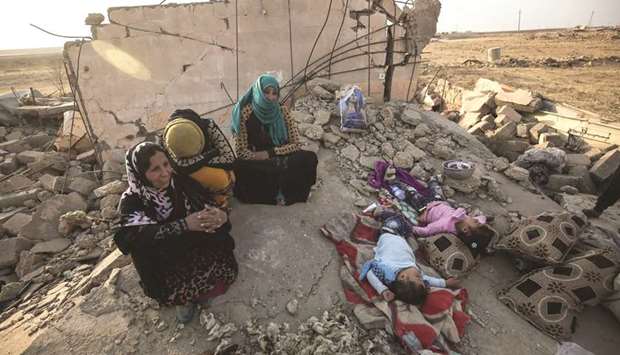
An Iraqi family sits on the rubble of their home in the village of Barzan, in the Zummar area of Nineveh province, northwest of Mosul, yesterday.