


South Korea’s riskier companies are selling bonds at the fastest pace in more than four years as investors encouraged by improving earnings shrug off military tensions in the peninsula.
SK Shipping Co and OCI Co were among firms with local ratings below AA- that sold 2.6tn won ($2.3bn) of Korean currency notes in the third quarter, the most since the first quarter of 2013, Bloomberg-compiled data show. After a public holiday the first week of October, benchmark borrowing costs for lower-rated firms were at the least in more than a year and Korean Air Lines Co met with brisk demand in a debt offering.
Investors are growing more bullish on riskier Korean firms amid expectations that the expanding economy and exports will boost their earnings. Profits of companies in the Kospi index are projected to rise about 64% over the next 12 months, compared with MSCI Asia Pacific Index firms’ 14%. Investors are also enticed by average yields on riskier Korean company notes that exceed 3% compared with about 2.3% on better-rated debt.
“Demand for corporate bonds with A grades will likely remain steady for a while because of the attractiveness of their yield,” said Kim Ki-myung, a credit analyst at Korea Investment & Securities Co.
“From a fundamentals perspective, negative rating actions seem to be mostly over as earnings improve.”
Only 10 companies’ debt ratings were cut in the first half, compared with 21 in the same period last year and 56 in 2015, Korea Investors Service data show.
Korea’s efforts to develop big domestic investment banks will also help boost demand for lower-rated corporate bonds, according to Kim. Approved securities firms with equity capital of 4tn won or more will be allowed to issue short-term promissory notes, in return for using at least half of the proceeds to help companies raise funds, the Financial Services Commission said in May. That includes buying company notes with A ratings or below, the FSC said.
Strong demand for lower-rated debt has sent the average spread on A graded corporate bonds down 13 basis points since June 30 to 123 basis points, the least in more than a year. Not all analysts are bullish toward the riskier bonds. The tighter yield difference may make corporate debt with A ratings less attractive going forward, said Park Jin-young, a credit analyst at HMC Investment Securities Co.
Also, investors who increase holdings of lower-rated securities may face losses if interest rates rise sharply, Park said. But she said she doesn’t expect that scenario for now.
Lower-rated companies are selling more notes than their initial plans.
Korean Air, rated BBB+ by Korea Investors Service and Nice Investors Service, doubled the size of its 1.5-year note to 160bn won last week after receiving 335bn won of orders.
Borrowers with A ratings in the pipeline to sell bonds include Lotte Logistics Co and Dongwon F&B Co, according to filings.
Korea Inc’s earnings have been helped by a surge in the nation’s exports to a record last month, driven by overseas demand for steel, semiconductors and petrochemical products. That suggests the economy is resilient even as the war-of-words between US President Donald Trump and North Korean leader Kim Jong-un heightens tensions.
“Companies whose ratings had to be cut have already been mostly downgraded,” said Kim Hong-joong, head of fixed income at Hanwha Asset Management Co, which oversees about 93tn won in assets.
“There are not many assets now that offer more than 3%,” he said, adding that the demand for corporate bonds with A ratings will likely continue through the year-end.
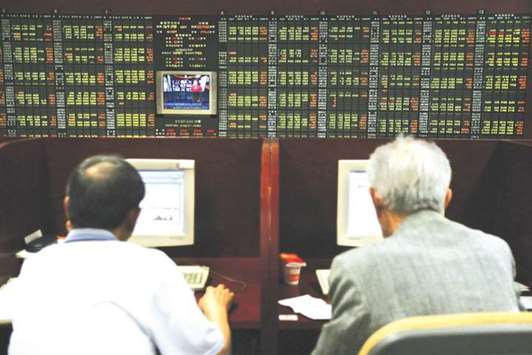
Traders look at a stock index board in Seoul. Investors are growing more bullish on riskier Korean firms amid expectations that the expanding economy and exports will boost their earnings.