


Tens of thousands of demonstrators rallied across Spain yesterday, calling for Spanish unity and demanding action to resolve a volatile political crisis over plans by Catalan separatists to declare independence.
A sea of Spanish flags filled Madrid’s central Colon Square as tension reigned with no solution in sight to Spain’s worst political crisis in a generation.
Some 50,000 people according to Spain’s central government joined a “patriotic” march organised by activists to defend the unity of Spain.
Another crowd, all dressed in white, filled a nearby plaza outside Madrid city hall in a separate rally calling for dialogue to end the crisis.
Similar rallies were held outside town halls across the country by a group called “Let’s Talk” under the slogan: “Spain is better than its leaders.”
Marching under banners reading “Hablamos?” and “Parlem?” – Catalan and Spanish for “Can we talk?” – protesters gathered at noon (1000 GMT) outside town halls in Madrid and Barcelona, as well as in Zaragoza, Seville, and Bilbao.
“Thank you for filling Cibeles [Square in Madrid] and tens of town hall [squares] across Spain. Now let the politicians do their jobs, that is what we are paying them for,” organisers said on their Facebook account.
The #parlemhablemos hashtag was the top trending topic on Twitter.
Ahead of yesterday’s protests, where people were asked to dress in white and avoid partisan slogans or chants, organisers distributed a
manifesto which read: “We know it’s possible to live together. Spain is better than its rulers and has demonstrated it many times.”
“We were concerned about the political discourse in these last days. They are heading towards a dead end,” Pablo Fernandez, one of the
organisers, told DPA.
These followed days of soaring tensions after police cracked down on voters during a banned October 1 Catalan independence referendum, prompting separatist leaders to warn they would declare unilaterally declare independence in days.
“Rajoy, you (expletive), defend the nation!” chanted one group of demonstrators as they marched into Colon Square waving Spanish flags as well as one bearing the Franco-era black eagle.
Separate from that group, 52-year-old Joaquin Penas, an off-duty cavalry colonel, said: “It’s reached a turning point and we need to get actively involved in the defence of Spain’s values as a nation.”
If Catalonia were to declare independence “it would be like cutting off an arm”, he told AFP, saying that there was “a lot of concern” about the government’s perceived lack of action to resolve the crisis.
“I don’t have much confidence in the government. It is not a very proactive government ... (Prime Minister Mariano) Rajoy is anything but a leader. To be honest, he’s awful,” Penas said. “There is a great deal of worry that the government has waited to play its last card too late.”
Yurena Diaz, a 36-year-old doctor, stood with her brown dog Quillo on a lead, said she wanted “dialogue before we lose our way”.
“The tension and violence have risen a lot. It is getting worse and worse,” she said. “It has created a lot of fear and that is very dangerous.”
“This is the most tense moment I can remember in Spain in my lifetime,” said demonstrator Fernando Pareja, a 19-year-old engineering student. “I think most Spaniards support the police action but I also think they acted too late.”
At the “white” rally in Madrid, actress Marta Muro, 67, in dark sunglasses, recalled Spain’s past decades of deadly conflict in the state’s battle against ETA armed separatists in its northern Basque Country region.
“I feel sad to think how bad our country is, how bad our government is,” she said. “I have nothing against the Catalans. We have to listen to them with respect and not with force or blood, like what happened with ETA.”
Natalia Bermejillo, a 21-year-old student, sat on steps with three friends near Madrid’s Colon Square.
She said she was not ashamed to join in a demonstration alongside small far-right groups, since they are supporting “the same cause” when it comes to Catalonia.
“If we do not join together there will be chaos,” she said.
She felt hurt by the Catalan separatists’ attitude to the rest of the country.
“They teach their children to hate Spain,” she said. “It is a very extreme ideology, and now it seems as if it is becoming contagious.”
Tentative signs emerged on Friday that the two sides may be seeking to defuse the crisis after Madrid offered a first apology to Catalans injured by police during the vote.
But uncertainty still haunts the country as Catalan leaders have not backed off from plans to declare the region independent.
And Catalan leader Carles Puigdemont said he has had “no contact” with the Spanish government to try to resolve the crisis.
“There are millions of people who have voted, who want to decide. We have to talk about that,” he told Catalan public television TV3 which will broadcast its full interview with Puigdemont today.
Some 5,500 people dressed in white packed Sant Jaume square in front of Barcelona city hall, according to municipal police.
Some waved white handkerchiefs but there were no flags.
Ruben Vidal, a 41-year-old DJ, came with his dog Ginger wrapped in a white flag with the word “parlem” – Catalan for “let’s talk”.
“You can’t expect Catalonia to remain in Spain just based on fear,” said Vidal before adding that politicians should “talk or resign”.
“This is producing a social rupture in Catalonia and this has to be resolved through dialogue, never via unilateralism,” Jose Manuel Garcia, 61, an economist who attended the protest dressed in white said. “I’m very worried. This will end badly and everyone will lose (without dialogue).”
Rajoy has vowed to block any independence move and has also rejected calls for mediation in a dispute that has drawn cries of concern all over Spain, and even from Barcelona and Real Madrid footballers.
The crisis has raised fears of unrest in the northeastern region, a tourist-friendly area of 7.5mn people that accounts for one-fifth of Spain’s economy.
Opponents of secession have called for a mass demonstration in Barcelona today.
Businesses and the government have kept up economic pressure on Catalonia, with several big companies announcing moves to shift their headquarters to other parts of Spain.
Puigdemont had been due to appear at the regional parliament tomorrow, but postponed it by a day, a spokesman said.
It remains unclear what he plans to say, although some separatist leaders hope he will use the opportunity to make a declaration of independence.
If Catalonia declares independence, Spain could respond by suspending the region’s existing autonomous status and imposing direct rule from Madrid.
The Catalan government on Friday published final results from the referendum indicating that 90% of voters backed the idea of breaking away from Spain. Turnout was 43%.
The vote was not held according to regular electoral standards, without regular voter lists or observers.
Recent polls had indicated that Catalans are split on independence.
With its own language and cultural traditions, demands for independence in Catalonia date back centuries but have surged during recent years of economic crisis.
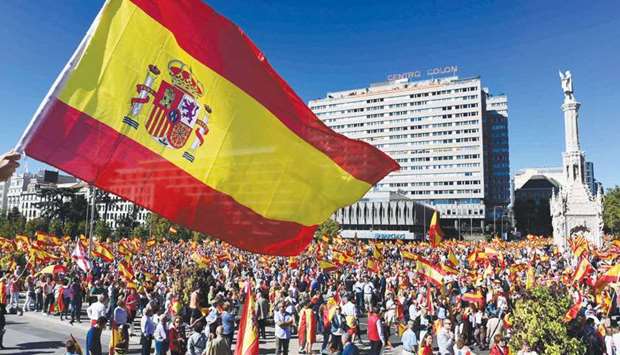
Protesters gather holding Spanish flags during a demonstration against Catalonia’s independence at Madrid’s Colon Square.