


Tropical Storm Nate gained strength yesterday as it headed toward
popular Mexican beach resorts and ultimately the US Gulf coast after
dumping heavy rains in Central America that left at least 22 people
dead.
Nate, which currently has 50mph (85kph) winds, is forecast to reach
hurricane strength by the time it makes landfall in the United States
late today on the north coast of the Gulf of Mexico.
New Orleans, where levees were breached during Hurricane Katrina in
2005, and other cities on the US Gulf coast were under hurricane watch.
The US National Hurricane Centre (NHC) warned of possible “hurricane
conditions” overnight on Mexico’s Yucatan Peninsula, where Cancun and
other Caribbean resorts are located.
By late today, those fearsome winds could drive a “life-threatening
storm surge” onto southern US states along the Gulf of Mexico.
“Nate is expected to make landfall ... as a hurricane,” the NHC said.
As of early yesterday, the storm was located directly offshore from
Belize, just south of the Yucatan Peninsula, with winds of 50mph (85kph)
that were expected to strengthen.
“The main threat to Belize is expected to be mostly thunderstorms and
heavy rain which are causing localised flooding,” the country’s
government said in a statement.
It warned people in low-lying areas to go to higher ground, and for boats not to venture to sea.
On Thursday, intense rains from the storm forced thousands from their
homes, uprooted trees, knocked out bridges and turned roads into rivers
in Costa Rica, Nicaragua, and Honduras.
Nicaragua bore 11 of the deaths, according to Vice-President Rosario Murillo.
In Costa Rica, where a national emergency was declared, eight people
died, including a three-year-old girl, after they were hit by falling
trees and mudslides.
An alert was issued for people to be wary of crocodiles that might be roaming after rivers and estuaries flooded.
Three other people were killed in Honduras.
More than 30 people are listed as missing in the three countries.
Nicaragua’s Murillo said that 800 people had been evacuated, nearly 600
homes were flooded and 14 communities were isolated because of rains
that had been falling for days.
More than 5,000 people were put up in shelters in Costa Rica after
having to abandon their homes because of flooding and the risk of
unstable ground giving way.
In the Gulf of Mexico, some offshore oil and gas rigs were evacuated
ahead of the storm’s advance, the US government Bureau of Safety and
Environmental Enforcement said in a statement.
The United States is recovering from two major hurricanes: Hurricane
Harvey that tore through Texas in August, and Hurricane Irma in
September.
Another powerful storm, Hurricane Maria, ripped through the Caribbean in
late September, wreaking destruction on a number of islands, including
Dominica and Puerto Rico.
Central America, the Caribbean, Mexico, and the southern United States
suffer an Atlantic hurricane season every year that runs from June to
November.
The unstable weather brings heightened risk of flooding and mudslides in many poor Central American nations.
This year’s season has been intense, with some areas in Central America
getting up to 50% more rain than average for September and October.
Costa Rica declared three days of mourning for those killed by Tropical
Storm Nate, and President Luis Guillermo Solis warned that although the
storm had passed, it was too early to say the danger had gone.
“This situation is deceptive because it will rain this weekend and the
ground is saturated, so landslides are possible,” he said.
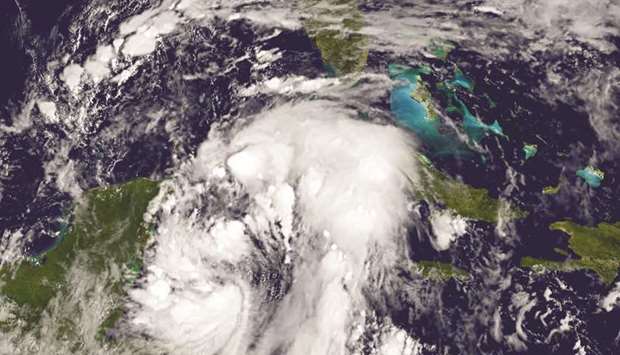
This image provided yesterday by the US National Oceanic and Atmospheric Administration (NOAA) shows Storm Nate in the northwestern Caribbean Sea.