


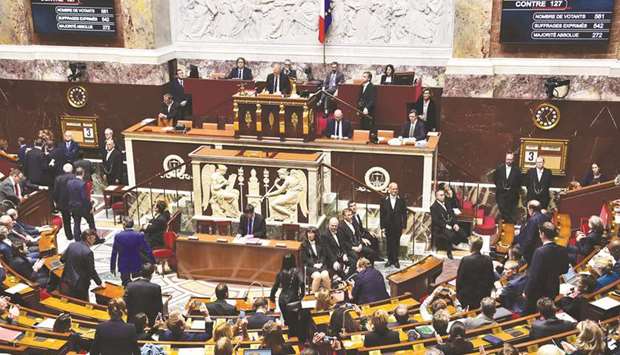
Ahead of the vote, Interior Minister Gerard Collomb described France as being “still in a state of war” as authorities struggle to deal with the threat posed by foreign religious extremists and homegrown militants.
More than 240 people have been killed in France in attacks since 2015 by assailants who pledged allegiance to, or were inspired by, the Islamic State (IS) group.
In the latest attack on Sunday, a man cried “Allahu Akbar” before fatally stabbing two women outside the rail station in Marseille.
Legislators in the lower house adopted the bill by a margin of 415 to 127.
“Lawmakers realise that today’s threat is serious and that we must protect ourselves against terrorists. This must be done in a way that balances security and freedom,” Collomb told reporters after the vote. “This text will help protect French people.”
Emergency powers in place since November 2015, when suicide bombers and gunmen carried out attacks in Paris and killed 130 people, have played a significant role in enabling intelligence agencies to disrupt plots, the government says.
The new legislation would see many of those emergency powers enshrined in law, with limited oversight from the judiciary.
The interior ministry, without approval from a judge, will be able to set up security zones when there is a threat, restricting the movement of people and vehicles in and out, and with power to carry out searches inside the area.
It will have more power to shut down mosques and other places of worship, if intelligence agencies believe religious leaders are inciting violence in France or abroad or justifying acts of terrorism.
Police will also have greater powers to raid private property, if they have judicial approval, and there will be an increased ability to impose restrictions on people’s movements, including via electronic surveillance tags, if they are regarded as a threat to national security.
A parliamentary commission will now seek compromise on amendments put forward by the Senate and Assembly before a second reading and definitive vote, expected in the middle of this month.
President Emmanuel Macron, painted by rivals as weak on security during his election campaign, has already acted to bolster counter-terrorism efforts, creating a task force in June to improve co-ordination among France’s multiple intelligence agencies.
The anti-terrorism bill has met little resistance from the public, with people still on the edge after the series of religious extremist attacks and smaller incidents that have followed. But rights campaigners say it will curb civil liberties.
“France’s new counter-terrorism bill grants the executive far-reaching powers to clamp down on the ability of ordinary people in France to worship, assemble, move freely, express themselves and enjoy their privacy,” Human Rights Watch said last month.
Jacques Toubon, head of France’s public human rights watchdog, warned that the legislation could be seen as targeting Muslims and risked unravelling France’s social cohesion.
In a July report to parliament, Toubon said the legislation gave no precise legal definition of terrorism, which left it open to abuse.
Nonetheless, some conservative opponents of Macron say the draft legislation, which is not as all-encompassing as the state of emergency currently allows, does not go far enough.
“We need to rearm the state,” right-wing lawmaker Eric Ciotti said in a radio interview before the vote.
He called for authorities to have greater powers to expel foreigners who threaten public safety.