


This weekend, Stephen Paddock opened fire on a country music festival in
Las Vegas, Nevada, from an overlooking hotel, killing at least 59
people and injuring more than 500 others. Paddock, a 64-year-old former
accountant with no criminal record, was ultimately found in his hotel
room, dead, with some 23 guns, including more than 10 assault weapons.
Police later found an additional 19 firearms, explosives, and several
thousands of rounds of ammunition in Paddock’s home. What the
authorities have not yet found, however, is a motive.
More details about Paddock’s mindset and objectives will probably come
to light in the coming days. But so-called “lone wolf” mass shooters –
individual perpetrators with no ties to any movement or ideology – are
not a new phenomenon, and these episodes have offered important clues
about the motivations and thought processes of mass shooters.
Most mass shooters do not survive their own attacks; they either kill
themselves or let police do the job. But those who have survived have
shown some common features, with narcissistic personality disorder and
paranoid schizophrenia being the two most frequent diagnoses. That was
the case with Anders Breivik, the Norwegian far-right terrorist who, in
2011, detonated a van bomb that killed eight people, before shooting
dead 69 participants in a youth summer camp. He remains in prison in
Norway.
A look at behaviour prior to attacks reinforces this view. In The Wiley
Handbook of the Psychology of Mass Shootings, Grant Duwe, the director
of research and evaluation for the Minnesota Department of Corrections,
examined 160 cases of mass shootings in the United States between 1915
and 2013.
Duwe found that 60% of the perpetrators had either been diagnosed with a
psychiatric disorder or exhibited signs of serious mental disturbance
before the attack. About one third had contact with mental-health
professionals, who had diagnosed them, most commonly, with paranoid
schizophrenia. The second most common diagnosis was depression.
Yet, given that most people who suffer from these disorders are harmless
to the public, these diagnoses do not tell the whole story. According
to Duwe, the difference may lie partly in an acute sense of being
persecuted – and an acute desire for revenge.
This view is corroborated by Paul Mullen, an Australian forensic
psychiatrist. Based on a detailed investigation of five mass murderers
whom he personally examined, Mullen concluded that such killers struggle
to reconcile their own grandiose ideas of themselves with an inability
to succeed at work or in relationships. The only explanation, they
decide, is that others are out to sabotage them.
In fact, Mullen’s study revealed that the path to mass murder is rather
stereotypical. All of Mullen’s subjects had been bullied or socially
excluded as children. They were all suspicious and rigid, qualities that
helped to deepen their isolation. They constantly blamed their problems
on others, believing that their community had rejected them; they
failed to consider that they themselves were too wearisome or
self-centred.
Mullen’s subjects obsessively held grudges against anyone whom they
viewed as part of the group or community that refused to accept them.
They ruminated relentlessly over past humiliations, a habit that fuelled
resentment and, eventually, revenge fantasies, leading them to use mass
murder to achieve infamy and to hurt those perceived to have hurt them –
even if it meant a “welcome death” for themselves.
Given this, there is usually a kind of warped logic to mass shooters’
choice of victims. In the case of school shootings, such as the
Columbine High School massacre of 1999, that logic is clear: to punish
those who have excluded the perpetrators socially. Likewise, workplace
rampages are often triggered by a firing or layoff. But even in cases
where the targets seem random, the logic usually emerges eventually,
even if it is a matter of punishing an entire community or society.
In Paddock’s case, many questions obviously remain unanswered, beginning
with why he chose that particular concert to attack. But the contours
of his story are beginning to emerge. Reinforcing the loner trope, one
neighbour said that the “weird” Paddock “kept to himself”; living next
to him was “like living next to nothing.” It has also been revealed that
in 2012, Paddock filed a negligence lawsuit against a Las Vegas hotel
where he had fallen; litigiousness can be a hallmark of the resentful
and paranoid.
Duwe argues that, contrary to popular belief, such gunmen do not “just
snap.” Though roughly two-thirds of mass public shooters experience a
traumatic event immediately before carrying out the attack – usually the
loss of a job or relationship – most spend weeks or even years
deliberating and preparing to get their revenge. In Paddock’s case, such
quiet planning may explain the armoury found in his home and hotel
room, which he rented several days prior to the attack.
After the massacre, more than half of mass public shooters either commit
suicide directly or provoke the police into killing them. This rate is
nearly 10 times higher than for homicide offenders in general. Does this
reveal, Duwe asks, just how mentally plagued these perpetrators are?
Perhaps they believe they can no longer bear the agony of life; once
they have “settled the score” for the perceived slights that have
produced it, there is no reason left to live.
Mullen argues that the script for this particular type of suicide has
become entrenched in modern culture, and continues to attract willing
lead actors. If we are unable to use the knowledge we have gleaned from
past experience to prevent them from taking the stage, they will
continue to take aim at audiences. – Project Syndicate
*Raj Persaud is a consultant psychiatrist and the co-author of the
forthcoming book The Streetwise Person’s Guide to Mental Health Care.
Adrian Furnham is Professor of Psychology at University College London
and the author of the forthcoming book The Psychology of Disenchantment.
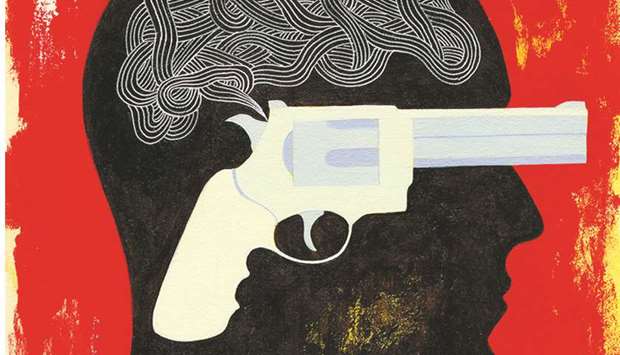
shooter