


 |
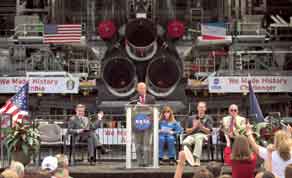
| Nasa Administrator Charles Bolden (centre) announces where four space shuttle orbiters will be permanently displayed at the conclusion of the Space Shuttle Programme during an event held at one of the Orbiter Processing Facilities at Kennedy Space Center in Cape Canaveral, Florida, on Tuesday. Enterprise, which currently is on display at the Smithsonian’s Steven F. Udvar-Hazy Center near Washington Dulles International Airport, will move to the Intrepid Sea, Air & Space Museum in New York. Discovery will move to Udvar-Hazy, Endeavour will be displayed at the California Science Center in Los Angeles and Atlantis (in background) will be displayed at the KennedySpace Center Visitor’s Complex |
Museums around the US had competed for the ageing shuttles, which are being retired due to high operating costs and to free up funds for a new generation of spacecraft that can fly farther from Earth.
The mothballing of Nasa’s shuttle fleet this year will hand over human space transportation to former arch-rival Russia 50 years after the first human space flight.
“Take good care of our vehicles. They have served the nation well,” said Nasa Administrator Charlie Bolden, who announced the shuttles’ final resting places at the Kennedy Space Center in Florida on the 30th anniversary of the first space shuttle flight.
Tuesday also marks the 50th anniversary of the pioneering launch in the then Soviet Union of Yuri Gagarin, the first human in space.
The shuttle Atlantis, which is being prepared for the 30-year-old shuttle programme’s 135th and final flight this summer, will stay in Florida, roosting at the Kennedy Space Center Visitor Center.
Endeavour, which is now at the launch pad for its final liftoff on April 29, is promised to the California Science Center in Los Angeles.
And Discovery, which completed its final mission last month, will go to the Smithsonian National Air and Space Museum’s Udvar-Hazy Center in northern Virginia.
The Smithsonian also will transfer the shuttle prototype Enterprise to the Intrepid Sea, Air and Space Museum in New York City. The Intrepid is a decommissioned US Navy aircraft carrier.
With the shuttles’ retirement, Nasa turns over the job of transporting astronauts to the International Space Station, a $100bn project of 16 nations, to Russia, once the US’ arch rival in the Cold War space race.
US dependence on Russian space transportation will end only if commercial companies develop passenger spaceships.
A handful, including the Boeing Co, Space Exploration Technologies, Orbital Sciences Corp, Sierra Nevada Corp, and Amazon founder Jeff Bezos’ Blue Origin, are trying.
“This is a necessary step that we had to take so that we can go on to do the next step,” Nasa astronaut Ron Garan said recently from aboard the orbiting space station.
“Our goal is to get out of the business of low-Earth orbit, turn that over to the commercial enterprises, and to get on to what Nasa and the other government agencies are really designed for - and that’s exploration.”
Rather than spending $4bn to $5bn a year to fly the shuttles, the US plans to develop spaceships that can travel beyond the station’s 220-mile-high (352 km-high) orbit, where the shuttles cannot go.
“I’m all in favour of turning over low-Earth orbit to commercial providers as soon as they’re ready, both cargo and crew. My concern is that they’re not ready yet,” said Michael Coats, director of Nasa’s Johnson Space Center in Houston.
“I’m a little bit frustrated because I think the rest of the world looks to us, especially in space, for leadership. I hope we can continue to maintain a leadership position. I think it’s very important geopolitically to do that,” Coats added.
Russia will be well-compensated for the transportation work. Rides to the space station, which now cost Nasa about $51mn per person, increase to $56mn in 2013 and are set to jump to $63mn in 2014.
The US has relied on Russian transportation before, most recently when Nasa grounded the shuttle fleet for repairs after the fatal 2003 Columbia accident.