Reuters/Santiago
President Barack Obama visited Chile yesterday on a trip to reassert US influence in Latin America even as he tried to sell his decision to press military strikes against Libya’s Muammar Gaddafi.

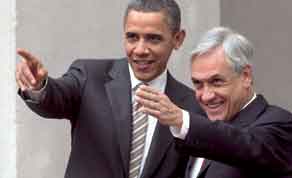
Chilean President Sebastian Pinera and US President Barack Obama point to their wives during an arrival ceremony at La Moneda Palace in Santiago, Chile, yesterday
Following his weekend visit to Latin America’s economic powerhouse Brazil, Obama was to lay out his vision for deeper political, trade and investment ties with the region.
He was also expected to hail Chile’s transition from military rule to stable democracy as a model for Libya and other countries in the Arab world, which is being swept by popular rebellions against autocratic rule.
The fierce air assault by US and European forces on Gaddafi’s loyalists in Libya has overshadowed Obama’s Latin America trip.
He is struggling to balance his handling of world crises, including US military intervention in a third Muslim country, with his domestic priorities of jobs and the economy considered crucial to his 2012 re-election chances.
Libya was certain to be the focus of attention at an Obama news conference yesterday following talks with Chilean President Sebastian Pinera.
Obama’s authorisation of a leading US military role in the UN-approved campaign against Libya has opened him up to criticism from both sides of the US political spectrum and threatens to complicate his domestic agenda.
Republican critics have demanded that Obama clarify the mission’s goal, saying he has done a poor job of articulating the mission Americans and that it is another example of the president’s failure to lead.
Some of Obama’s fellow Democrats have also expressed concern about entangling the US in Libya when its forces are already at war in Iraq and Afghanistan.
The strikes are sanctioned under a UN resolution to protect Libyan civilians by all necessary means from Gaddafi loyalists trying to suppress a popular uprising against his rule.
Obama, in a brief statement to reporters on Saturday in Brasilia as his five-day Latin American tour got underway, said he had ordered limited US military action to support an international coalition to shield Libyan civilians from harm.
In his meeting with President Dilma Rousseff, Obama found himself in the awkward position of meeting a leader whose government had abstained in last week’s UN Security Council resolution giving the go-ahead for the strikes on Libya.
Obama is juggling the US involvement in Libya with the deadly nuclear crisis in Japan, while at the same time seeking to promote deeper ties in a fast-growing Latin America he sees as a fertile region for US job-boosting exports.
Latin America was optimistic when Obama took office in 2009 he would give the region the respect it feels it deserves due to its strong economic performance. But two years later there is a sense that relations have been neglected while Obama battles urgent domestic challenges and foreign wars.
Washington’s history with Latin America has included heavy-handed use of US power for much of the 20th century to periods of inattention to the region over the past decade.
While General Augusto Pinochet’s 1973 military coup in Chile, which human rights groups say the US backed, evokes painful memories for many, a shift to the right last year after two decades of center-left rule underscores the transition to a free-market democracy.
Chile’s solid economic growth, success in easing poverty and peaceful transfer of power make it a poster child for transition in Latin America and Obama will stress this in a speech in Santiago.
Dan Restrepo, Obama’s top Latin American adviser, said the president would hold up the lessons learned by Chile during its transition as an example for other countries, while bringing up the crisis in Japan in the context of Chile’s own experience with natural disasters.
Seeking to position its economy as a regional financial hub that rivals Brazil, Chile is hoping Obama’s visit will help establish it as a key player that pushes above its weight alongside Latin America’s major economies.
Japan’s post-quake nuclear disaster threatened to cloud the centerpiece of Chile’s agenda with Obama - a nuclear energy cooperation agreement.
But the government went ahead and signed it with the US ambassador to Santiago before Obama’s arrival, and officials accept that events in Libya and Japan will likely steal the limelight from what is seen as largely a symbolic stopover.