


Germany’s chancellor hopeful Martin Schulz addressed elderly voters yesterday in a last-ditch attempt to close the gap between his centre-left Social Democrats (SPD) and the ruling conservatives.
Chancellor Angela Merkel’s government – in which the SPD is a junior partner – is “unable to guarantee dignity in old age”, Schulz said during a press conference in which he outlined four policy positions that would be “non-negotiable” in post-election coalition talks.
At 45, Germany has the oldest median age of any European Union member state.
According to the German statistics office (Destatis), 56.1% of people eligible to vote in the September 24 election are 50 years of age and older.
Schulz said the SPD would under no circumstances raise the retirement age from 67 to 70, a policy that Merkel has also paid lip service to but that has been refuted by Finance Minister Wolfgang Schaeuble, a senior figure in her Christian Democrats (CDU).
“Deserting these hard-working people is not something that will happen on our watch,” said Schulz, whose SPD is currently polling at 24% compared to the CDU’s 38%.
The CDU’s electoral lead means that there is unlikely to be a feasible majority for any Schulz-led coalition, and that a second grand coalition between the CDU and the SPD – usually viewed as a last resort – is one of the few viable options.
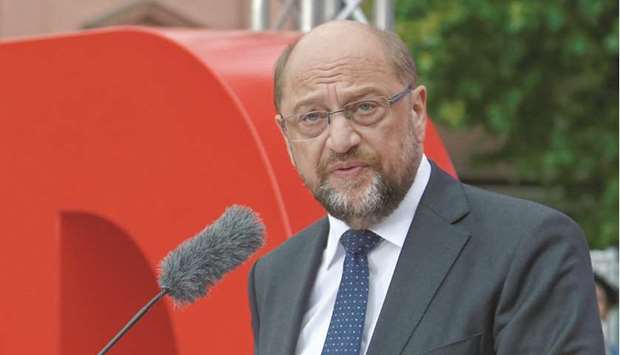
Martin Schulz