


Theresa May has caused further ill will in Brussels by rejecting an invitation to address the European parliament in public, EU sources have said, instead insisting she will only talk to its leaders behind closed doors.
The prime minister had been asked by the parliament’s president, Antonio Tajani, to speak to a full session of the chamber to explain her position on Brexit.
The parliament will have the power of veto over any withdrawal agreement struck between the UK and the EU. May had revealed in June that she was in discussions about an appearance.
According to senior EU sources, Downing Street has now informed Tajani that May was only willing to talk in private to the leaders of the parliament, rather than face a plenary session in full public view.
One EU source said the decision had disappointed a number of key figures in the parliament at a time when the UK was keen to win support among MEPs for its argument that a comprehensive free-trade deal was in the interests of all parties in the negotiations.
May would have followed in the footsteps of Gordon Brown, Tony Blair and Margaret Thatcher if she had faced MEPs in the chamber.
“This is yet another own goal,” one EU official said of May’s decision.
Downing Street did not deny that May had turned down an offer to address the European parliament, but said she would attend a meeting with Tajani and the chairs of its political groups.
“The prime minister has confirmed to President Tajani that she would be happy to address the conference of presidents. A date will now be arranged with his team,” a No 10 spokesman said. No date has yet been set for her attendance at the group, which meets about twice a month.
Elmar Brok MEP, a German member of the European parliament’s Brexit steering committee, said: “The European parliament remains ready to offer flexible solutions. Why make enemies? It’s ridiculous.”
David Cameron, as prime minister, was to address a meeting of European parliament leaders in Brussels – not a full plenary session – in February 2016, but cancelled as he sought to negotiate a deal with the EU on the renegotiation of the UK’s membership terms before last June’s referendum.
The development comes as minutes of a European commission meeting in Brussels revealed the low opinion EU negotiators hold of the UK’s Brexit secretary, David Davis.
They show that Brussels was unimpressed after the first round of Brexit talks in July, and the commission’s president, Jean-Claude Juncker, suggested Davis was unwilling to engage fully with the negotiations.
The minutes of a meeting on July 12, published yesterday, read: “Winding up the discussion, the president expressed his concern about the question of the stability and accountability of the UK negotiator and his apparent lack of involvement, which risked jeopardising the success of the negotiations.”
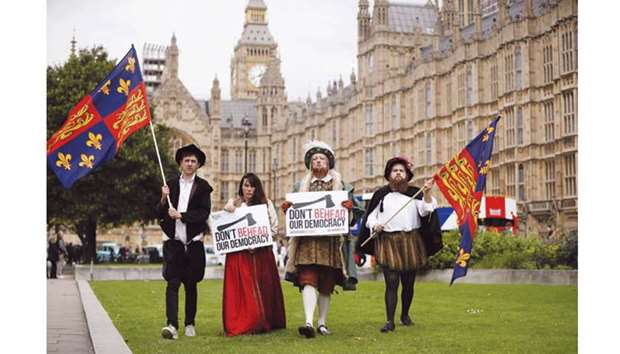
Protesters dressed in Tudor costume, including one dressed as King Henry VIII, hold signs protesting elements of the European Union Withdrawal Bill that was being debated by lawmakers in the House of Commons in London yesterday.