


Hurricane Irma strengthened into a highly dangerous Category 5 storm yesterday as it barrelled toward the Caribbean and the southern United States, even as Texas and Louisiana still reeled from devastating Hurricane Harvey.
Hurricane warnings were in effect for much of the Leeward Islands, the British and US Virgin Islands and Puerto Rico as the storm packed winds of up to 175mph (280kph), the US National Hurricane Centre (NHC) said.
“Irma becomes an extremely dangerous Category 5 hurricane,” the NHC said yesterday, adding that it could strengthen. “Preparations should be rushed to completion in the hurricane warning area.”
Category 5 is the highest NHC designation.
A hurricane of this magnitude can tear off roofing, shatter windows, uproot palm trees and turn them into projectiles that can kill people.
Irma was about 270 miles (440km) east of the island of Antigua and moving west at about 14mph (22kph), the NHC said.
It was too early to forecast Irma’s exact path or any effects have on the continental United States, it cautioned.
But several projections have it passing over the Dominican Republic, Haiti and Cuba before turning north toward Florida and then possibly swinging up the US East Coast.
A US aircraft carrier with a field hospital and dozens of aircraft able to conduct rescue or supply missions has been positioned protectively in the area, according to Alejandro de la Campa of the Caribbean division of the US Federal Emergency Management Agency (FEMA).
Local press identified the carrier as the USS Kearsarge.
Puerto Rican Governor Ricardo Rossello urged the 3.4mn residents of the US territory to leave areas expected to be lashed by high winds and torrential rains overnight and seek refuge in one of 460 hurricane shelters.
“This is something without precedent,” Rossello told a news conference.
He will ask US President Donald Trump to declare a federal state of emergency even before the storm passes to allow disbursement of US emergency funds.
Florida Governor Rick Scott said yesterday that he also asked Trump to make a “pre-landfall” emergency declaration.
Irma is expected to reach southern Florida on Saturday.
Scott said he spoke with Trump on Monday night after the governor declared a state of emergency for all of Florida’s 67 counties.
He said the president “offered the full resources of the federal government”.
TV station WIPR in Puerto Rico showed long lines of shoppers stocking up on bottled water, flashlights, batteries and food.
Gary Randall, chief executive officer of the Blue Waters Resort on Antigua’s north coast, said staff had boarded up windows and stripped trees of coconuts and fronds and secured anything that could become a hazard.
“I wasn’t that nervous yesterday, but today I’m nervous,” Randall said by telephone, adding that he expected the hotel’s beach to be swept away and much of the 108-room property to be flooded.
Antigua and Barbuda Prime Minister Gaston Browne urged residents to stay in their homes during the storm.
Airlines cancelled some flights to the region, and American Airlines added two extra flights on Tuesday from St Kitts and St Maarten to Miami.
The NHC also issued a hurricane watch for the Turks and Caicos Islands and the southeastern Bahamas as well as the northern coast of Haiti near its border with the Dominican Republic.
Irma would be the second powerful hurricane to thrash the United States in as many weeks.
Residents of Texas and Louisiana were still reeling from Hurricane Harvey, which struck Texas as a Category 4 hurricane on August 25.
It dumped several feet of rain, destroying thousands of homes and businesses, killing an estimated 60 people and displacing more than 1mn others.
Meanwhile, as Hurricane Irma bore down on the Caribbean, a new storm emerged in the Atlantic Ocean, the NHC said.
Tropical Storm Jose had formed in the open Atlantic to the east of Hurricane Irma.
The NHC did not issue any coastal watches or warnings for Jose, which is currently located some 1,505 miles (2,420km) east of the Lesser Antilles.
It said Jose was moving west-northwest at 13mph (20kph) with maximum sustained winds of 40mph (65kph).
The NHC said Jose was expected to strengthen during the next 48 hours and could become a hurricane by Friday.
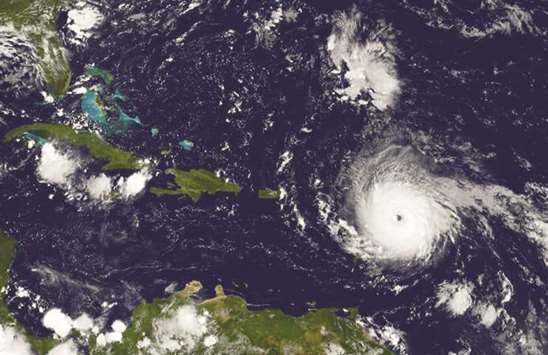
This image obtained from Nasa’s GOES Project shows Hurricane Irma on Saturday, September 2. Irma picked up strength and has become an ‘extremely dangerous’ Category Five hurricane as it approached the Caribbean yesterday, the Miami-based National Hurricane Centre reported. Irma is about 440kms east of the island of Antigua, packing maximum sustained winds of 280kph.