


World leaders expressed grave concerns yesterday over a “new level” of threat from North Korea after Pyongyang conducted its sixth and most powerful nuclear test.
Pyongyang claimed it had tested a hydrogen bomb that can be loaded onto an intercontinental ballistic missile (ICBM), saying it was a “perfect success,” according to its official mouthpiece, the Korean Central News Agency.
Several world powers warned of an escalating threat, even as others were more cautious in the absence of outside confirmation that the test at 12.30pm (0330 GMT) was actually of a hydrogen bomb.
Japanese Prime Minister Shinzo Abe said North Korea’s “nuclear and missile development programmes pose a new level of a grave and immediate threat” and “seriously undermines the peace and security of the region.”
Just five days ago, North Korea launched a ballistic missile that flew over the northern Japanese island of Hokkaido and plunged into the Pacific Ocean.
British Foreign Secretary Boris Johnson joined Abe in declaring the test “another provocation” and stressing that the moves towards a hydrogen bomb that could fit atop a missile “would unquestionably present a new order of threat.”
US President Donald Trump left open the possibility of attacking North Korea as he prepared to meet with his national security team and as aides floated further sanctions.
Trump - who had in August warned North Korea of unleashing “fire and fury” if it did not stop provoking the US - told reporters “we’ll see” when asked directly whether the US would attack North Korea.
He also criticised the Pyongyang regime, Washington’s ally South Korea as well as China in a series of tweets.
North Korea’s “words and actions continue to be very hostile and dangerous to the United States,” Trump said, calling it “a rogue nation which has become a great threat and embarrassment to China, which is trying to help but with little success.”
South Korea’s “talk of appeasement” with North Korea will not work, Trump said, adding that Pyongyang will “only understand one thing.”
Treasury Secretary Steven Mnuchin said the US was preparing new sanctions to further isolate North Korea.
South Korea vowed to push for the most powerful sanctions yet at the UN Security Council, with President Moon Jae-in saying his country would not allow its neighbour to continue to advance its nuclear and missile technologies.
Russian President Vladimir Putin and his Chinese counterpart, Xi Jinping, agreed to “appropriately deal with” North Korea’s nuclear test, China’s state news agency Xinhua reported.
Norway-based geological monitoring agency NORSAR said the magnitude of the test was estimated at 5.8 and the explosive yield was approximately eight times more powerful than the nuclear bomb used over the Japanese city of Hiroshima in August 1945.
The blast’s explosive yield was estimated at 120 kilotons of TNT based on the seismic magnitude, NORSAR said.
NORSAR - which monitors earthquakes and nuclear explosions - said it recorded the signals at its site in the southern county of Hedmark, and that the shock originated from an underground nuclear test at North Korea’s Punggye-ri test site.
Earlier, the US Geological Survey said it had detected an “explosion” of 6.3 magnitude near Sungjibaegam in the country’s north-east.
Seoul’s weather agency said the artificial quake generated by the blast was 9.8 times more powerful than North Korea’s fifth nuclear test in September 2016.
The test came hours after North Korean leader Kim Jong-un inspected what state media said was a missile-ready hydrogen bomb.
Kim was present at the facility where the nuclear weapon was loaded onto a missile, KCNA said, releasing a picture of Kim next to the device.
The bomb had an explosive power that was adjustable up to “hundreds” of kilotons and could be detonated at high altitudes, it added.
The test prompted a series of emergency calls between top officials, including US Secretary of State Rex Tillerson and his counterparts in Japan and South Korea.
In January 2016, North Korea claimed it had successfully tested a hydrogen bomb, its fourth test of an atomic device prior to the fifth in September of that year, but Western experts doubted at the time that the explosion had the power of a hydrogen bomb.
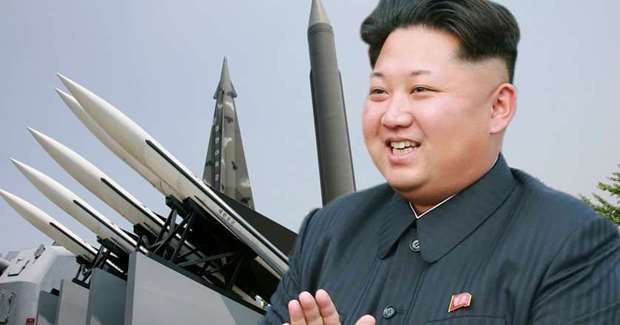
North Korean leader Kim Jong-un